
Choosing an older Esprit Blanc for Vinous Icons
In February, I'll be heading to New York to pour at the third annual Vinous Icons event. This event is a big honor for us; last year's guest list reads like a "who's who" of the great wine estates of the world. We have an opportunity to pour an older wine the second night. But which vintage?
In February, I'll be heading to New York to pour at the third annual Vinous Icons event. This event is a big honor for us; last year's guest list reads like a "who's who" of the great wine estates of the world.
We'll be involved in the event in two ways. Eric Guido, who reviews our wines for Vinous, has invited me to work with him on a retrospective tasting lunch focused on the Esprit de Beaucastel and Esprit de Tablas. We will show off a dozen vintages, from our first-ever 2000 to the newest 2023, and talk the guests through the making, aging, and evolution of the wine. That will be amazing.
The other way in which we'll be represented is that I'll be pouring at their two grand tastings. It's not unusual for an event like this to stretch over two nights. But it is unusual to be offered the opportunity to pour different wines each night. We are limited to two wines per night, which works well for us as it allows us to pour our Esprit de Tablas and our Esprit de Tablas Blanc. I'll be showcasing our newest vintage of both (the 2023) on the first night.
For the second night, I thought it would be fun to show the same two wines, but an older vintage of each. We've done a few recent retrospective tastings of our Esprit red, including for the article Eric Guido wrote this spring on Tablas Creek. I feel confident in my choice of vintages on the red side and chose the 2006 Esprit, which has been just glorious the last few times I've opened one.
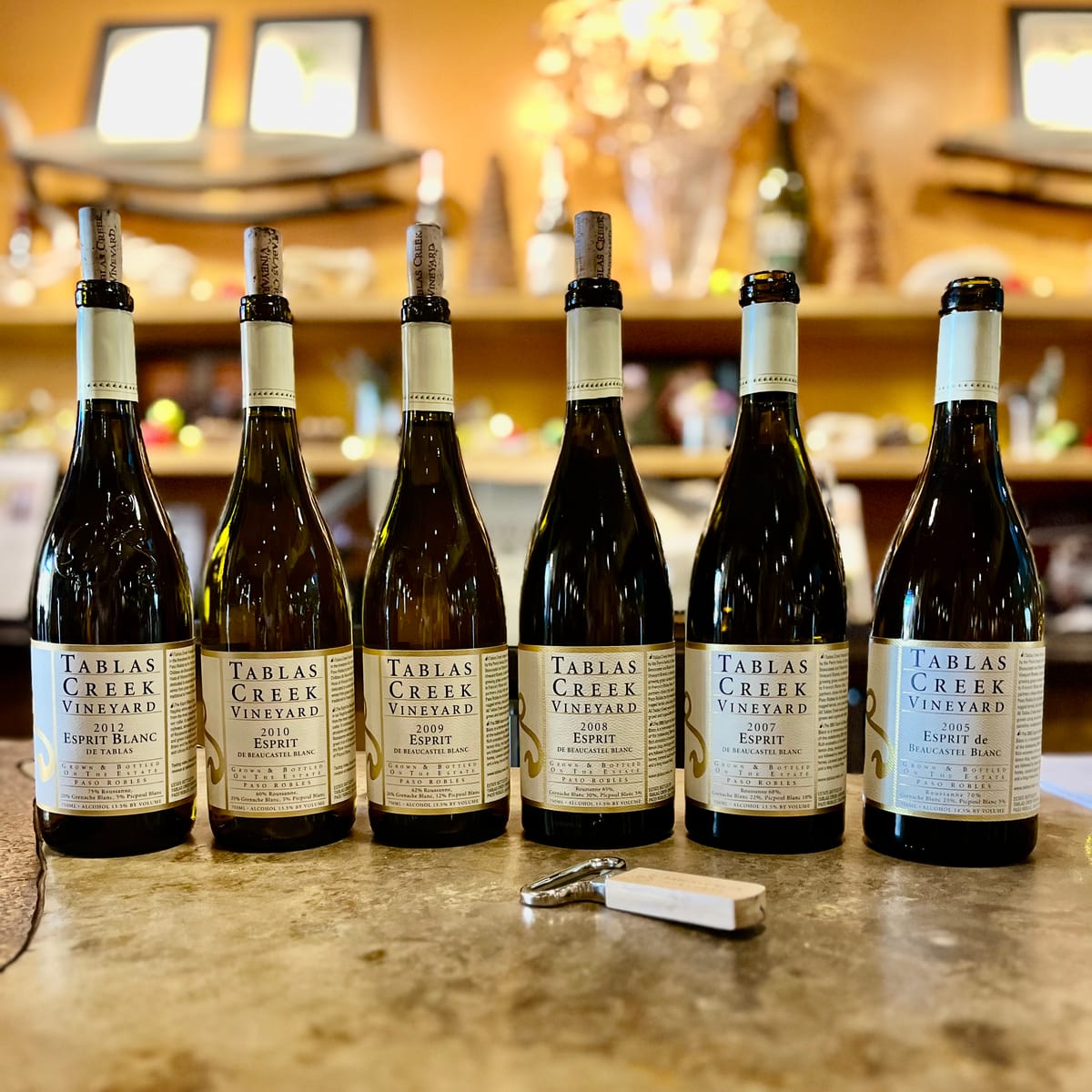
I open our older whites less often, and we haven't done a full vertical tasting of the Esprit Blanc since one we did (just in-house, since we couldn't host public events) in 2020. So, I looked at our inventory of older vintages that might feel at home alongside the 2006 Esprit red and found six viable options, and then invited the cellar team to taste them with me and help me make my choice. I thought I'd share my notes on those six wines, and then some conclusions at the end. I've linked each wine to the page on our Web site if you'd like detailed production notes or the tasting notes of the wines at bottling.
- 2012 Esprit de Tablas Blanc (75% Roussanne, 20% Grenache Blanc, 5% Picpoul Blanc): A pretty nose of marzipan, sweet green herbs, honeycomb, preserved lemon, and spice. The mouth is salty, with flavors of roasted hazelnut, creme caramel, and golden raisin. But while this makes it sound sweet, it's fully dry with good structure, a lifted camphor note, and a lingering impression of pineapple core. Very pretty, but showing a touch more evolved than I was expecting from a year that I've always found light on its feet.
- 2010 Esprit de Beaucastel Blanc (60% Roussanne, 35% Grenache Blanc, 5% Picpoul Blanc): A younger nose than the 2012, with flavors of new honey, tarragon, citrus leaf, and dried apricot. The mouth is rich but lifted, with flavors of grilled lemon and pineapple, fresh apricot, and salty minerality. Good acids come out on the finish which left a chalky mineral note and a hint of watermelon rind. I've always loved this vintage, from our coolest-ever year, and this showing was no exception.
- 2009 Esprit de Beaucastel Blanc (62% Roussanne, 26% Grenache Blanc, 12% Picpoul Blanc): A more savory nose of rendered pork fat, chamomile, lanolin, jasmine, petrichor, and dried orange peel. The mouth is floral, almost soapy with notes of lavender and honeydew easing into the essence of an orange tree, including flowers, pith, and leaf. Quite grippy texture. Still powerful, but more expressive than it was the last time I opened one. It seems like it's following a similar path to the one taken by the 2009 Esprit de Beaucastel red.
- 2008 Esprit de Beaucastel Blanc (65% Roussanne, 30% Grenache Banc, 5% Picpoul Blanc): A fully mature but compelling nose of honeycomb, nutmeg, crystallized pineapple, and baked apple. The palate is in a similarly lovely place, with flavors of pineapple juice, salted caramel, orange peel, and creme brulée. The finish shows chalky mineral notes with an appealing tropical note of green herbs like wheatgrass and lychee. I can't imagine this getting any better than it is right now.
- 2007 Esprit de Beaucastel Blanc (68% Roussanne, 22% Grenache Blanc, 10% Picpoul Blanc): A spicy nose of sarsaparilla and petrichor, caramel apple and lemongrass, with a wildflower honey pungency. The mouth is juicy, like lemon drop and spun sugar, papaya and apple peel. There's a deep, almost wheaty element like rolled oats or the topping of a fruit crisp. The only way that this fell a little short for me was that it was a little low in acid. But if you like opulence, it's one for you.
- 2005 Esprit de Beaucastel Blanc (70% Roussanne, 25% Grenache Blanc, 5% Picpoul Blanc): The nose is spicy and cooler-toned than most of the others, pine forest and juniper over caramel and baked apple. The mouth shows butterscotch, citrus pith, quince and green herbs. Mature and powerful, with lanolin and a little tannic bite on the finish.
I asked each of the participants to vote for two favorites, and the 2010 and 2008 tied for first place. I ended up choosing the 2008 to send to New York, as I think it will stand up proudly alongside the powerful 2006 Esprit red, not that I could have gone far wrong. A few other concluding thoughts:
- The ageworthiness of Roussanne is remarkable. You typically hear about the importance of tannin, acid, and sugar as keys to wines aging. Roussanne has a little tannic character, for a white, but it's usually low in acid and (at Tablas Creek) always dry. And yet it ages remarkably. A few years ago, I had the occasion to taste the 2001 Roussanne, our first-ever varietally bottled wine. At two decades old, it was remarkable. We don't know why it ages so well, but it does, consistently.
- There wasn't a lot of varietal difference in the wines in that era. We had a pretty consistent model, with between 62% and 75% Roussanne and just two other grapes (Grenache Blanc and Picpoul) making up the rest of the blend. It's exciting to have the other three white Rhone grapes (Bourboulenc, Picardan, and Clairette Blanche) to work with now, all of which are higher-acid than Roussanne. These grapes, and our decision to bring the Roussanne percentage down to about 45%, have allowed us to build more vibrancy into recent vintages of Esprit Blanc. I very much appreciate what this does for the wines in their youth. Will it compromise their ageability? I don't think so, given how well the 2001 Esprit Blanc, which only had 45% Roussanne, has shown over the last decade, but we will see.
- If this richer Roussanne-dominated character is something that appeals to you, that's the model we're using to build the Panoplie Blanc. The en primeur offer that includes the first-ever vintage of Panoplie Blanc is active through next week. Fair warning!
- Anyone coming for Vinous Icons is in for a treat. Please make sure you let me know you read this blog if you do!