

Understanding for whom wholesale wine sales works, and for whom it doesn't
In 26 markets, we're with one of the "Big 3" distributors. In 2025 those states sold 39% less than the size of the markets would predict. In the 25 markets where we're with an independent, we saw an overperformance of 22%. Thanks to Alfonso Cevola, I finally understand why.

I had the pleasure of being asked to participate on a panel at the always-valuable WiVi Central Coast industry conference here in Paso Robles a few weeks ago. The subject was the right strategies for wineries in the wholesale distribution market, and I was joined on stage by DAOU's Neb Lukic, Alma Rosa's Stefan Matulich, and O'Neill's Maeve Pesquera, who moderated our discussion. Thanks, Amanda Wittstrom Higgins, for snapping and sharing the photo at the top of this post.
The wholesale wine market has had a rough last five years. Before Covid, wine sales had plateaued after decades of steady growth. After a massive spike in 2020, the trend line reached negative territory in March of 2021, and has seen annual declines in the 7% range for the last few years. The chart below is excerpted from the Silicon Valley Bank State of the US Wine Industry 2025 report. While the 2026 report didn't include a similar chart, according to SipSource (the source of the chart's data) both the first half of 2025 (down 6.5%) and the second half of 2025 (down 9.7%) were if anything worse:
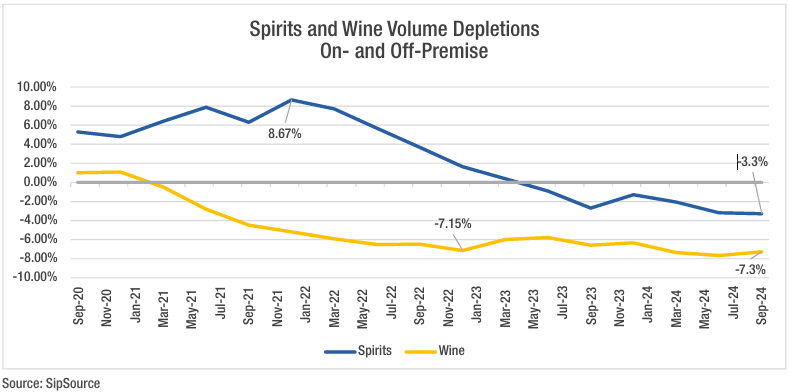
The net result has been that some of the country's highest-profile distributors have been contracting, shedding jobs and brands, being bought up by rivals, and in one case simply departing California, the country's largest wine market.
And yet, we grew in wholesale in 2025. Not much, mind you, but our wholesale depletions were up 2%. Looking at where we were selling wine highlighted something that I had felt was true but hadn't taken the time to back up with numbers. You can, broadly speaking, divide up the distribution world into the three large national players (Southern Glazer's, RNDC, and Breakthru, who together have controlled more than 60% of the market for the last decade) and everyone else (hundreds of small to medium-sized distributors, typically active in only one or a handful of nearby states). For our national distribution, we are a part of the Vineyard Brands portfolio. Their collection of 100+ wineries includes some larger producers and many smaller ones like us. Because Vineyard Brands has decided not to align nationally with any one wholesaler, instead choosing to allow their regional managers to choose the distributor (or distributors) in each state that they feel will best represent the portfolio, we have what is in many ways a perfect test case of what sorts of distributors perform best for us.
I did a little calculating on how we were doing in states where we were with one of the "Big 3" distributors, and in those states where we're with a smaller independent. The 26 markets where we're with one of the big guys together represent 36% of national wine sales for a California winery. Those same states represented just 22% of Tablas Creek's sales, or 39% less than the size of the markets would predict. In the 25 markets where we're with an independent, representing 64% of the national market, we've sold 78% of our wine, an overperformance of 22%. Now it's important to note that there are exceptions! You might expect that a faraway market like Florida, where we're represented by Breakthru, would be one of the underperformers. You would be wrong; we do great there. But on average we do better when we're in a smaller house.
I had always thought that the reason behind why a small or medium-sized winery like us didn't do as well in a bigger distributor was because of attention. But larger distributors also have larger sales teams. So, it should theoretically even itself out. I'm massively oversimplifying the numbers here, but getting 1% of the attention of 100 salespeople should get you about the same amount of net sales as getting 10% of the attention of 10 salespeople. But I recently read an article by wholesale veteran (and blogging pioneer) Alfonso Cevola that provided the mechanism I'd been searching for to explain why we underperformed in bigger houses. The article was called How pay-for-performance hollowed out wine distribution and I haven't stopped thinking about it.
Alfonso identified the introduction of pay-for-performance (PFP) instead of the older system of paid on commission as the critical moment in which larger wholesalers lost the ability to represent their producers large and small. From his article:
Under commission, a rep’s income was tied to the breadth of their book. Every case moved was money in their pocket, which meant every wine in the portfolio was worth their time, including the small Barolo producer without a marketing budget, the Etna Rosso that needed a story told. A commissioned rep had financial reasons to know their accounts deeply: which sommelier was quietly building a regional Italian list, which independent retailer would take a chance on an unfamiliar producer if someone spent thirty minutes on the story. Niche products had a pathway to market because the rep had skin in their success.
PFP replaced that alignment with predetermined goals tied to specific SKUs, funded by supplier contributions to bonus pools. Large suppliers bought their way into the performance metrics. Reps received meagre base salaries – in most major markets, salaries that required a second income or taking on a roommate – supplemented by management-discretionary bonuses tied to pre-selected targets. The rational response was to cherry-pick the highest-paying goals and deprioritise everything else. The shopping-list effect replaced the book. A wine without a budget behind it became invisible – not because buyers didn’t want it, but because the incentive structure made selling it economically irrational for everyone in the chain.
Why this disproportionally impacted smaller producers is more than just that larger wineries had larger budgets to support the pay-for-performance. It's that in a large portfolio the incentives are structured so that in order to hit them that needs to be the rep's whole focus:
The bonus pool mathematics that govern what gets sold cannot be made to work across the full width of a national portfolio in a declining market. Prioritisation is inevitable – and under PFP, it is purchased by suppliers with the largest budgets, not earned by wines with mere market potential. The bigger the operation, the more pronounced the distortion. A regional distributor working 200 SKUs can chase goals and still touch most of its book. A near-national operation working with thousands of suppliers cannot. The ceiling is structural, and it does not expand with the portfolio.
It's not as though sales of non-prioritized brands fall to zero under the PFP system. Large wholesalers are happy to accumulate brands and deliver them when ordered. But they have set up a system where a rep who goes out and sells those wines is working against their self-interest. That also produces a brain drain, where reps who want to bring their accounts what will work best for the accounts are pushed out of larger distributors in favor of reps who will do as they are told (or at least, as they're incentivized) and better represent the large brands whose incentives pay the bulk of their salaries. And that's likely another reason why we do better with smaller wholesalers. The sales reps who are passionate about niche wines like ours tend to be pushed toward the smaller independent distributors where they can have more freedom to sell the wines they love instead of selling what's on goal that week or month.
Finally, a smaller wholesaler is more likely to be able to buck the larger trends than a larger wholesaler is. Some of this is purely sample size. The big distributors are exposed to enough of the market that it's hard for them to significantly outperform the trend line. But much of these massive distributors' size has been achieved by buying smaller distributors and accumulating brands. As the big distributors are forced by market realities to cut salespeople and marketing budgets, they are losing suppliers to smaller competition. That means that smaller distributors can be growing even in a shrinking market by welcoming refugees from the larger houses. I flew out early last year to do a kickoff at one such distributor, and the mood there was positively giddy. They had grown the year before and were adding brands and talented salespeople who had been cut from some of the specialty teams that the large houses were discontinuing as an unstainable luxury. Brands already in those houses can benefit.
I don't want to make out that wholesale is easy if you just pick the right partner. It's a competitive world out there, and you need to be prepared with the right pricing and a product that stands out within your category if you want to get into the book of an established wholesaler. Smaller wholesalers can also struggle to pay their bills, and there are not-insignificant costs to bear in licensing and logistics.
But my WiVi panel offered some hope and some solid advice. On stage were wineries that ranged in size from small (Alma Rosa) to medium (Tablas Creek) to large (O'Neill) to very large (DAOU). Each of us had been able to find success in recent years in the difficult wholesale market. We all agreed on three principles:
- Understand the goals of why you're in the wholesale market. This will depend on what size you are. If you're a small or medium-size winery, it's probably not profit. After all, direct-to-consumer sales are always more profitable and at smaller volumes wholesale rarely is. But it can be a remarkable way of increasing your reach and profile. It is a great way to increase your production and therefore reduce the cost of producing each case, or of moving inventory that is beyond the capacity of your direct-to-consumer sales without cutting prices and potentially damaging your brand. It means that you've got potentially thousands of advocates out telling customers about your wines. If you're larger, then you're employing economies of scale and are looking to wholesale to provide bottom-line profit.
- Find representation that fits your size and profile. It should be intuitive at this point that if you're a small winery, you probably want a small distributor. Unless you're larger or higher-profile, you are likely to get lost in a larger book. Of course, smaller operations tend to work at higher margins, so your wines will be a little more expensive than they would be in a large house. On the other hand, if you're a larger winery you probably need the reach of a larger sales team and the logistics and ordering power of a larger operation. It's worth noting that the impact of higher wholesaler margins is also going to be greater when wines are in broader distribution in other states and accounts can easily look up comparative prices online.
- Put in the work to support those efforts. Whatever your size and aims, this was something that all of us on stage emphasized. You cannot expect, in this crowded and competitive market, for a distributor to succeed selling your wines without your help. There may have been a time when you could just make a good product, price it fairly, and leave the rest to the distributor. But it's definitely not enough now. You should build into your wholesale budget the time and expense of visiting your top markets, working with their salespeople, calling on restaurants and wine shops. Success breeds success, and a distributor who sees success with your wines will stock more and will work on it more even when you're not there. If you're small, it's probably your proprietor or your winemaker doing that work. If you're medium-sized, maybe you have a National Sales Manager to carry the brunt of it. And if you're larger, build the biggest sales team you can support. Neb talked about DAOU's work building a sales team of over 100 people. No wonder the big distributors pay attention to him in a way they don't to me. He matters to their bottom line, yes, but they also have people working with them all the time. But even if that's well beyond your means (as it is ours) there is work to be done. It's not a coincidence that we scheduled and hosted 79 consumer events outside Paso Robles last year, and are on pace to match that this year, all hosted by one National Sales Manager, one Director of Marketing, a few of our winemaking team, and me.
I've thought and written a lot on this blog over the years about the first bullet point, above. Check out the Advice to Wineries tag if you'd like a sample. I've written a fair amount, especially recently, about the third bullet point. But that second bullet point isn't something I've addressed directly. Thank you, Alfonso, for pulling the curtain back on something I'd always wondered about.