
It's not just your imagination. The heat in March was unprecedented.
The photos we're sharing look more like May than they do like the beginning of April. And no wonder. March 2026 would have been the warmest April in our history, and all sorts of unprecedented outcomes are on the table.
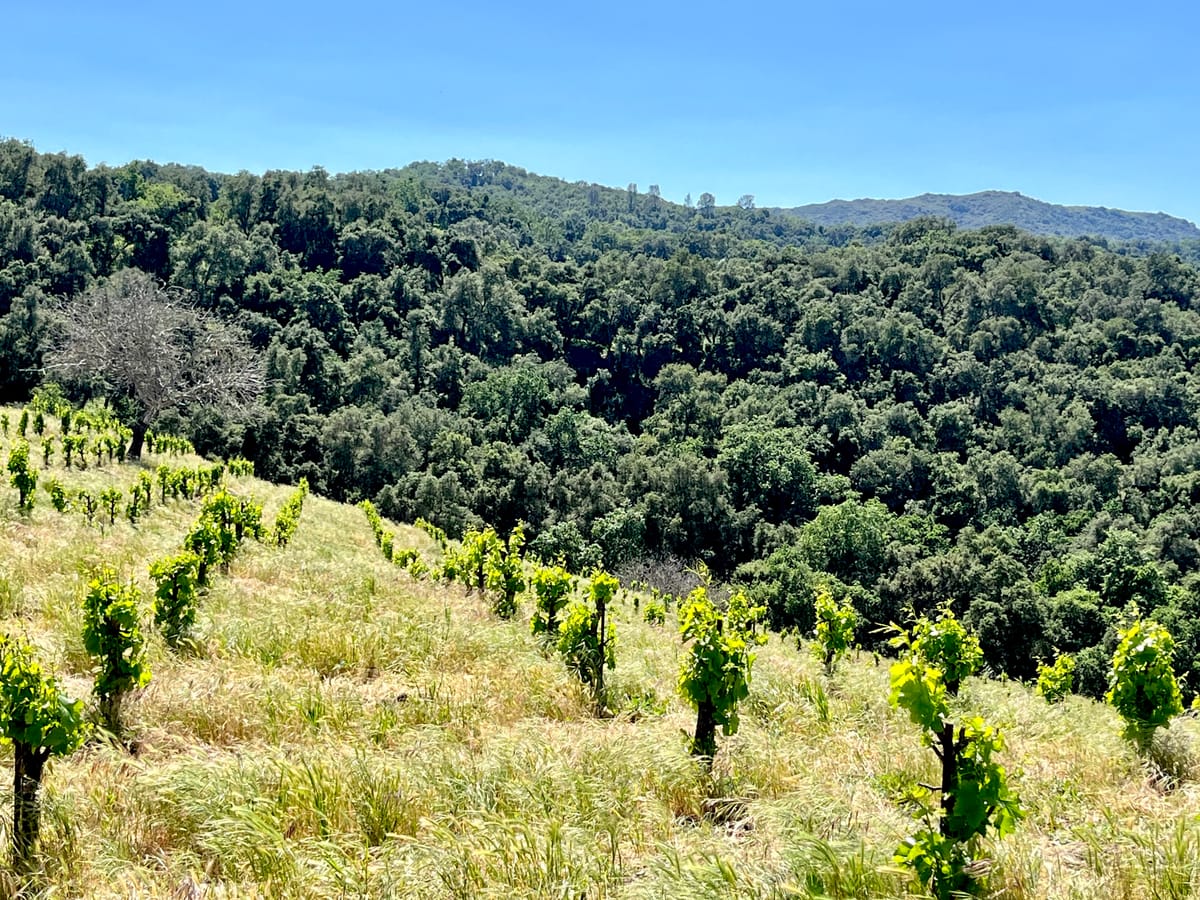
In the budbreak blog that I published on March 16th, I shared that we were looking at our second-earliest beginning to the growing season here since we started keeping records (after only the warm and dry 2016 growing season). That was largely because of all the warm, sunny weather we had earlier in the winter. Yes, we got good rain, but between the rainstorms it was sunny and warm.
That sunny, warm weather continued into March and went into overdrive in the second half of the month. Our average high temperature for the entire month was 79.3°F. We had 16 days top 80°F and four top 90°F. Our low temperatures weren't that low, either. We slept with all our windows open the whole second half of the month, as low temperatures bottomed out in the low-50°s F. There wasn't a single below-freezing night in March, and the second half of the month didn't see any days drop below 40°F. It was lovely, but it also just felt wrong. And no wonder; at the time of the spring equinox we were seeing weather that would have been normal for the summer solstice.
I agree. This event has been meteorologically astonishing, and its impacts will be felt long after it ends in terms of record low snowpack, sharply increased wildfire risk, and extreme low watershed runoff/streamflow into summer and beyond.
— Daniel Swain (@weatherwest.bsky.social) March 25, 2026 at 2:25 PM
[image or embed]
It's worth taking a little time to explain just how unusual that is here. We normally see several frosty nights in March, and highs in the 60°s or 70°s. Our first 90°F day isn't usually until May. Sure, summers here are warm, but this is still March! One way that we measure heat accumulation is Growing Degree Days (GDDs). This is a measurement of the number of daylight hours over a certain threshold that is tied to the photosynthesis of a given crop. Typically, we don't even start measuring GDDs until April. The average total GDD accumulation at the end of April here at Tablas Creek in the time frame that covers 2010-2025 was 231, with the range being between 134 (in 2010) and 307 (in 2013).
At the end of March this year we had accumulated 348 GDDs.
Let that sink in for a moment. The March that we just saw was warmer than the warmest April of the last 15 years. In fact, it was warmer than the average May that we've seen over that time (342 GDDs).
I plotted the last two years in a single chart to give you a sense of how 2026 stacks up against 2025, a relatively normal year. Each day's total (measured against the left axis) is in blue for 2026 while each day in 2025 is in gray. The cumulative lines (measured against the right axis) are dark orange (2026) and light orange (2025):
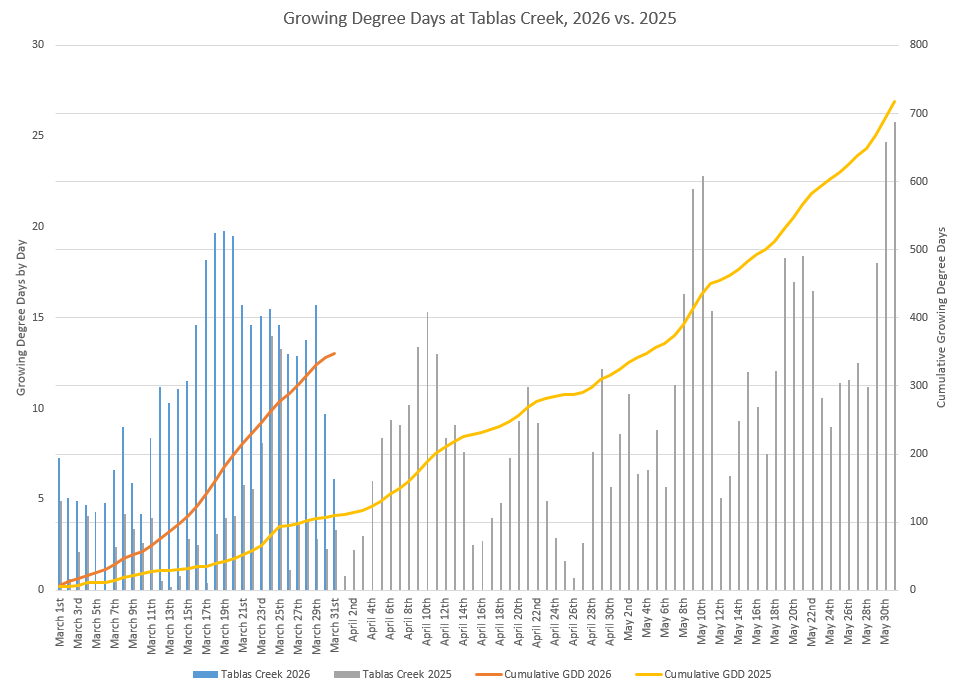
There wasn't a single day in March 2026 where we didn't accumulate more heat than that same day in March 2025. We accumulated more heat in the first 31 days of the 2026 growing season than we did in the first 65 days of the 2025 growing season. Put another way, it wasn't until May 4th, 2025 that we accumulated the total growing hours that we achieved by March 31st, 2026.
The vineyard has noticed. Walking around feels more like May than it does like the beginning of April. The grasses, which were powered by plenty of water and warmth, are turning gold already, setting off the bright green of the new growth:
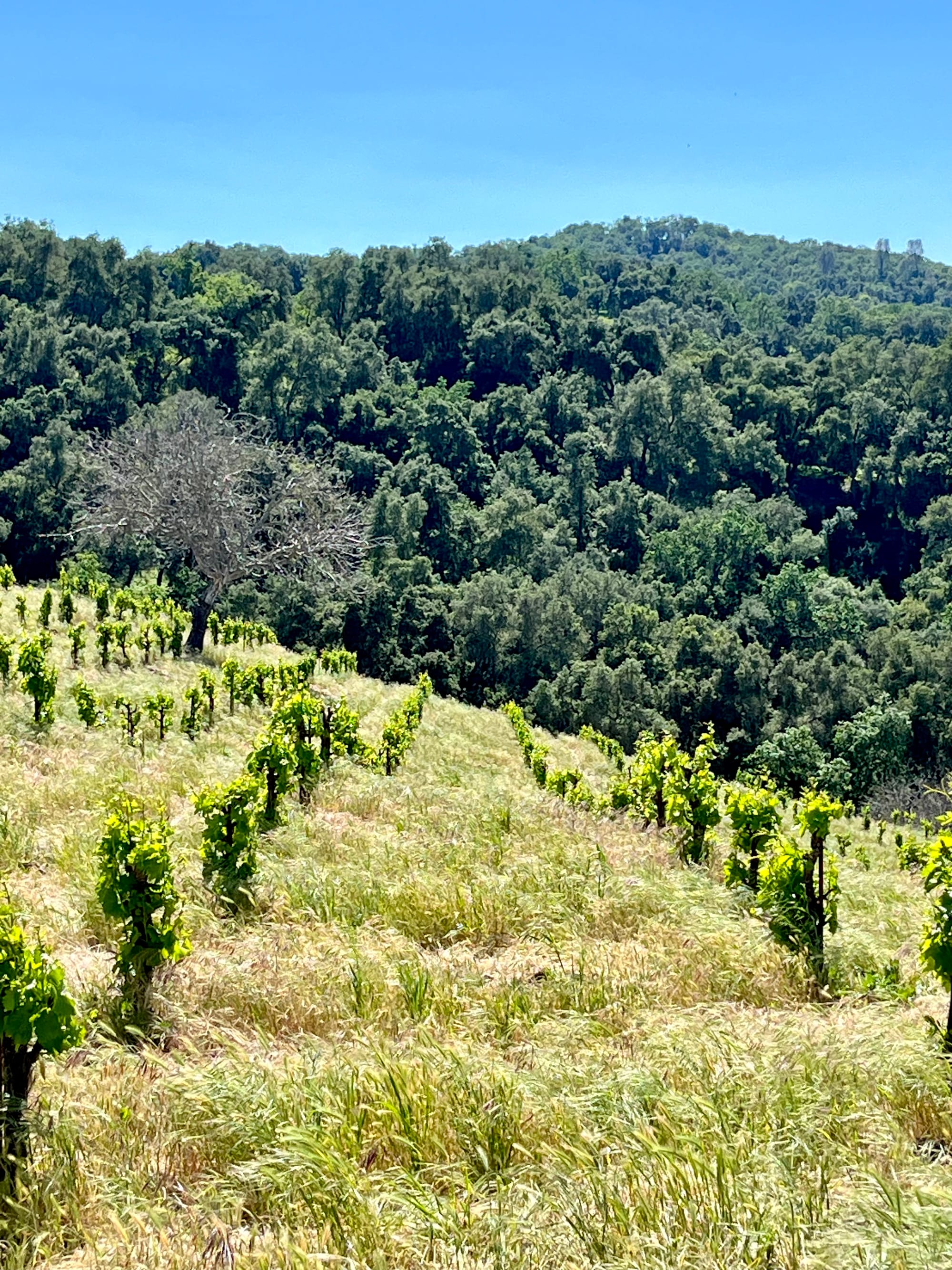
The growth is at a stage that is more usual for the beginning of May than for the beginning of April, including flower clusters on grapes as diverse as Viognier, Syrah, Grenache Blanc, Counoise, and Grenache (pictured):
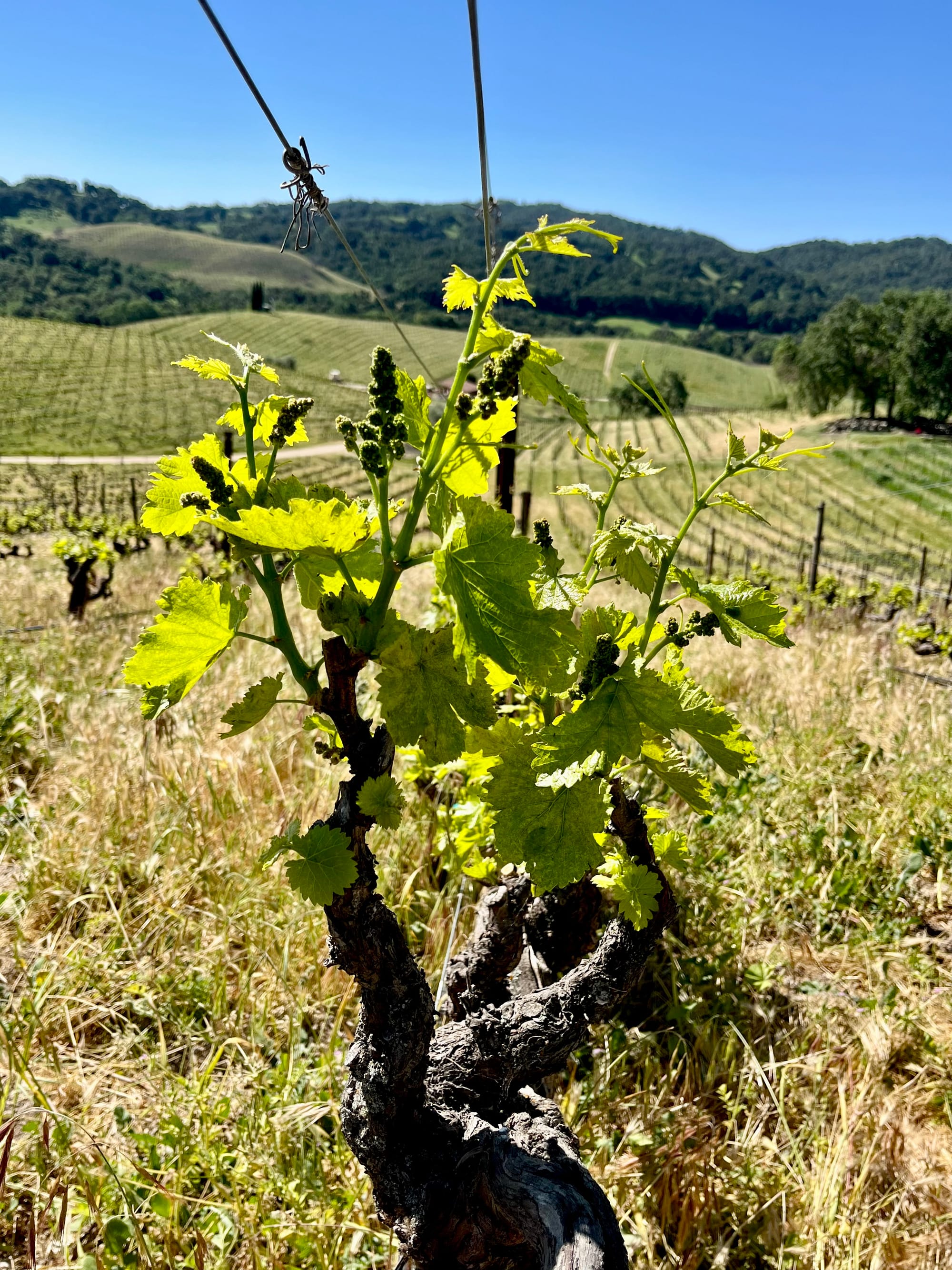
We're working hard to get the growth of the cover crops under control, spading, crimping, and mowing as we feel appropriate for each block. Note how far out these Counoise vines are. It's truly remarkable for a grape that's usually dormant still:
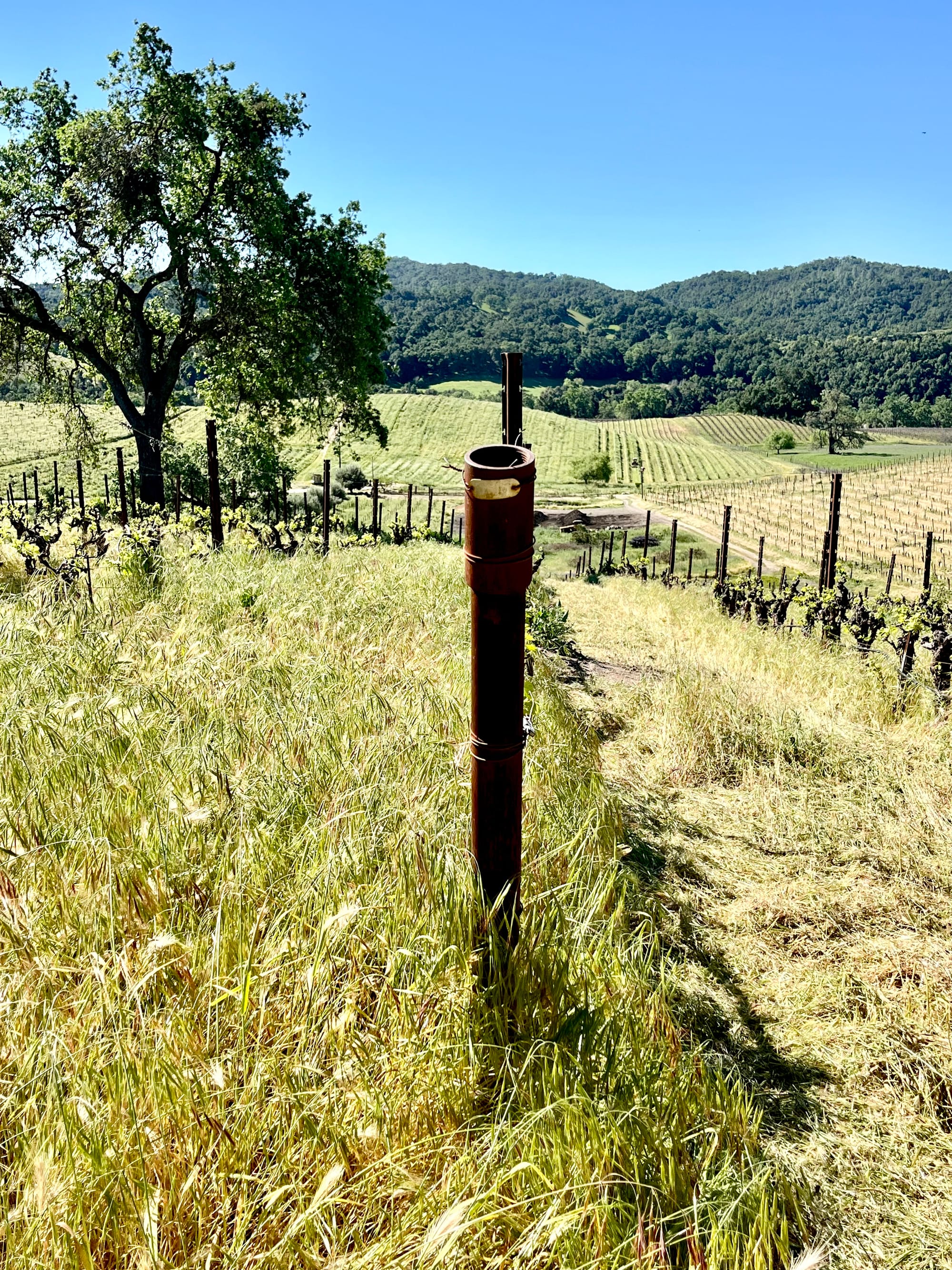
As for what all this means, it's hard to know since it's literally unprecedented in our history. We do know that we'll have a longer-than-usual frost season, given that we don't feel truly safe from frost until mid-May. We dodged a chilly night last week, and the next week or so looks pretty benign. After that, we'll see. If we do get a frost, all bets are off. With the vines this far out, the impacts would likely be massive. The vines would have to re-sprout while having spent most of their reserves already in producing the growth we're seeing now. But what if we don't get frost?
The only recent vintage where we saw comparably early budbreak (2016) also saw a warm March and no frost events. Even so, the GDD total of 173 was less than half of this year's total. April 2016 saw an additional 264 GDDs added to the total, which is still less than we saw this March. And yet if you go back and read the blogs I tagged that year with "Harvest 2016", there are several "earliest ever" mentions. We started harvesting August 18th, and finished on October 8th.
Some of the potential outcomes this year sound pretty outlandish. Could we start harvesting in July? It's possible, though I tend to think it's unlikely. Could we be done by the end of September? Absolutely. It might not even be terrible to be done early, given that there's talk of a "super El Nino" coming that could result in significant and earlier-than-usual rain events arriving in California.
But one thing we do know. We've never seen anything like what we've seen so far. Buckle up for a bunch more "earliest ever" posts.