2025 Red Blending: A Magical Year for Mourvedre
I asked the blending team to sum up 2025. Chelsea said, “It was powerfully structured and chewy, even on varieties you wouldn’t expect.” Austin commented, “They’ve all got liveliness. Nothing feels weighed down by its depth.” And Craig summed it up: “It’s the year of Mourvedre and Roussanne.”
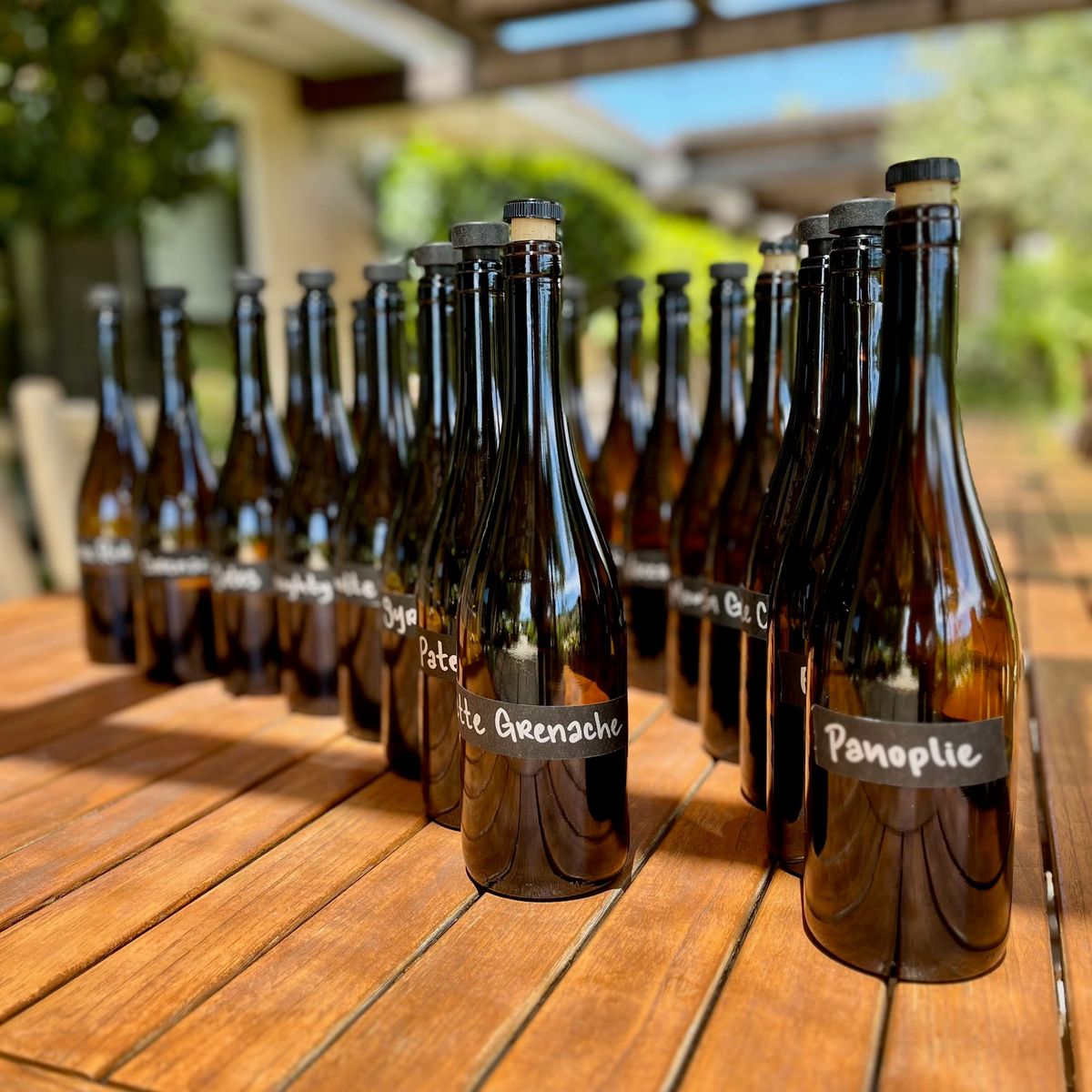
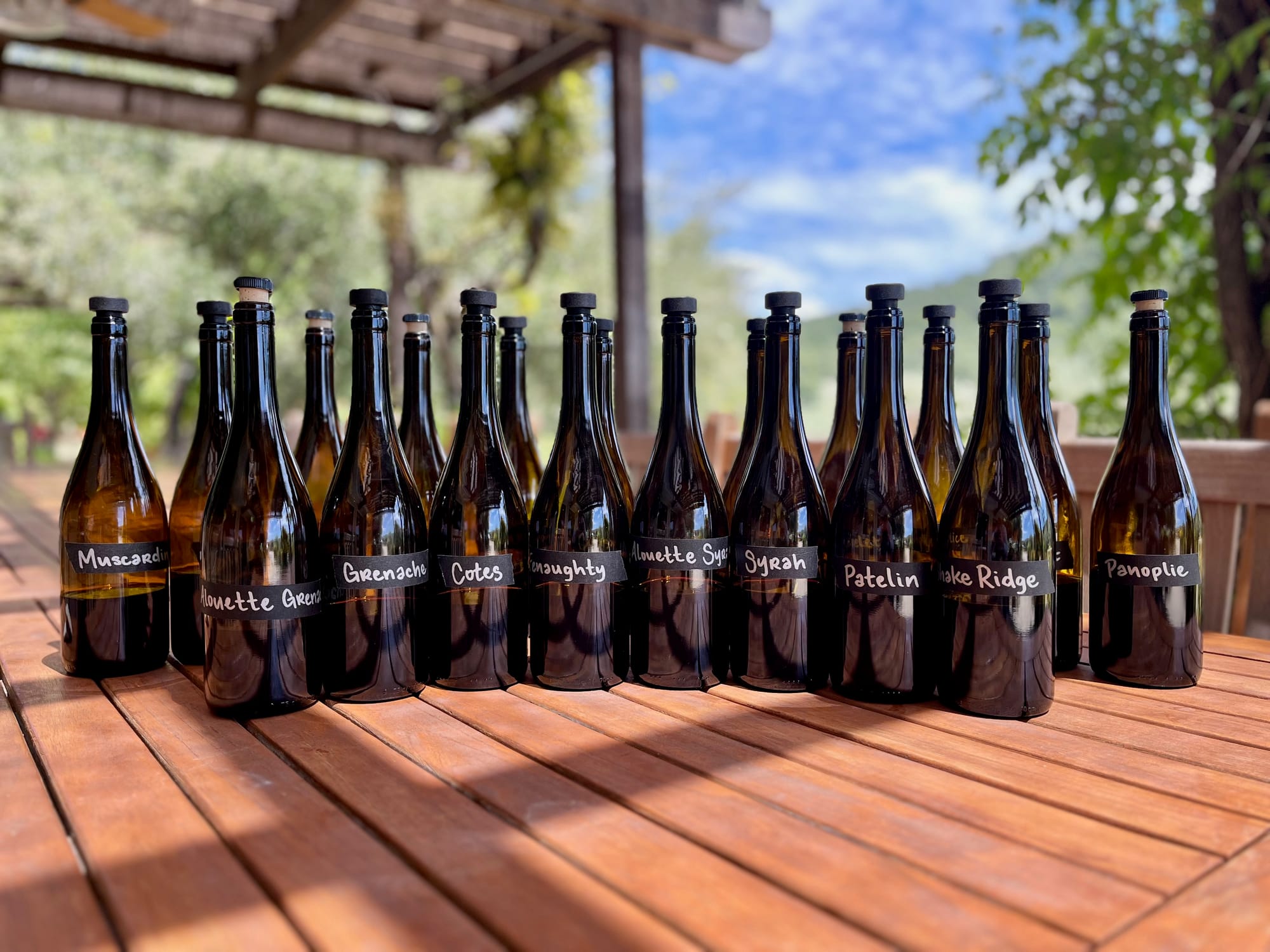
Three things quickly became clear when we finally got to sit down and taste the twenty (!) red wines we’d made from the 2025 vintage. It was a year of lushness and ample fruit, with plenty of structure. It was a year where we had solid quantities of everything, and especially Grenache. And it was the best Mourvedre year any of us could remember. From the minty cranberry and pink peppercorn of the Counoise to the brooding black licorice and baker’s chocolate of Syrah, the salted plum, sarsaparilla, and warm oak leaf character of En Gobelet to the cassis, meat drippings and bay leaf character of Esprit of which Neil said, “just a sniff brings me home,” each wine showed the combination of concentration and precision that is a signature of our very best years. After completing our white blending a few weeks ago, we were pretty confident we’d love what we tried, but sometimes the greatest white vintages don’t translate quite the same to reds. We needn’t have worried.
2025 was a vintage marked by its moderation. It was dry the winter before, but not too dry. It was quite cool all spring, but we didn’t get any damaging frosts. When it finally did warm up in August, we still avoided any extreme heat, with the eight 100°F days we received the fewest since 2011. Then, just after we started picking in late August it cooled back down, and we saw heat accumulation (as measured in growing degree days) 30% below average after September 1st. All this led to our second-longest harvest ever, spanning eleven weeks. The moderate temperatures meant that we didn’t see the dehydration that impacted both our tons per acre and our yield of gallons per ton that we did in 2024.
Like the 2025 vintage, our blending week was cooler than last year, to the point that Chelsea set up the “yule log” setting on the big TV screen in our conference room to help us ward off the chill:
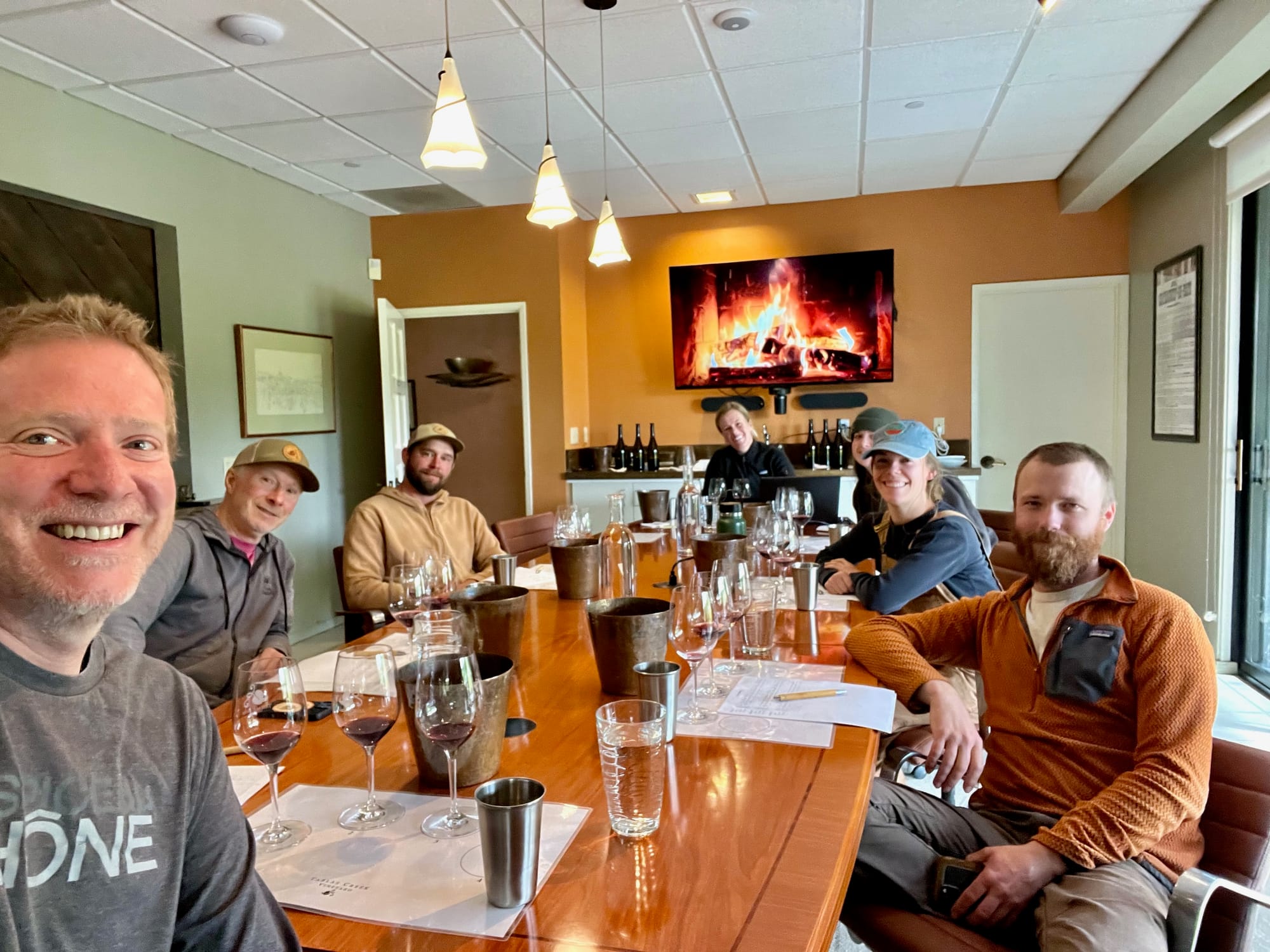
We take the blending process in steps and build consensus rather than relying on one or two lead voices to determine the wines' final profiles. This is something that we’ve learned over the years from the Perrin family, our French partners in Tablas Creek. After all, when you have nine family members involved in a multi-generational business, as they do at Beaucastel, it's a good policy and good family relations to make sure everyone is on the same page before you go forward. The same is true with a partnership like Tablas Creek where both founding families have equal ownership.
We try to do most of our tasting in the morning because that's when everyone's palates and brains are freshest. Afternoons are for the explorations of vineyard or cellar, or brainstorming, or tasting of wines out of our library (and of course for catching up on all the other work we'd do in a normal week). We began the week, as we always do, by tasting each of the different red lots in the cellar, which in 2025 numbered a substantial 83, a 26% increase over 2024. We broke the tasting of these lots across two days. The first day saw us attack our most plentiful grape (Grenache, with 27 lots) and then run through some of the curiosities, like Vaccarese, Tannat, and the lots from our purchased grapes. The second day we began with some of our lighter-bodied grapes like Counoise, Cinsaut, Terret Noir, and Muscardin, and then dove into Mourvedre and Syrah.
As a general rule, we keep our different harvest lots separate until they've finished fermentation so we can assess their quality and character before we have to decide which wines they fit best in. After all, a Mourvedre lot could potentially go into any of six wines: Panoplie, Esprit, En Gobelet, Cotes, Patelin, or the varietal Mourvedre. So our goal at this first stage of blending is to give each lot a grade that's reflective of its overall quality, and to start to flag lots that we think might be particularly suited to one wine or another. This component tasting is also an opportunity for us to get a sense of which varieties particularly shined or struggled, which helps provide direction as we start to brainstorm about blends.
We grade on a 1-3 scale, with "1" being our top grade (for a deep dive into how we do our blending, check out this blog by Chelsea from a few years back). We also give ourselves the liberty to give intermediate "1/2" or "2/3" grades for lots that are right on the cusp. For context, in a normal year, for every 10 lots we might see three or four "1" grades, five or six "2" grades and one "3" grade. As you can see from my notes, this year I gave out a lot of "1" grades and almost no "3" grades:
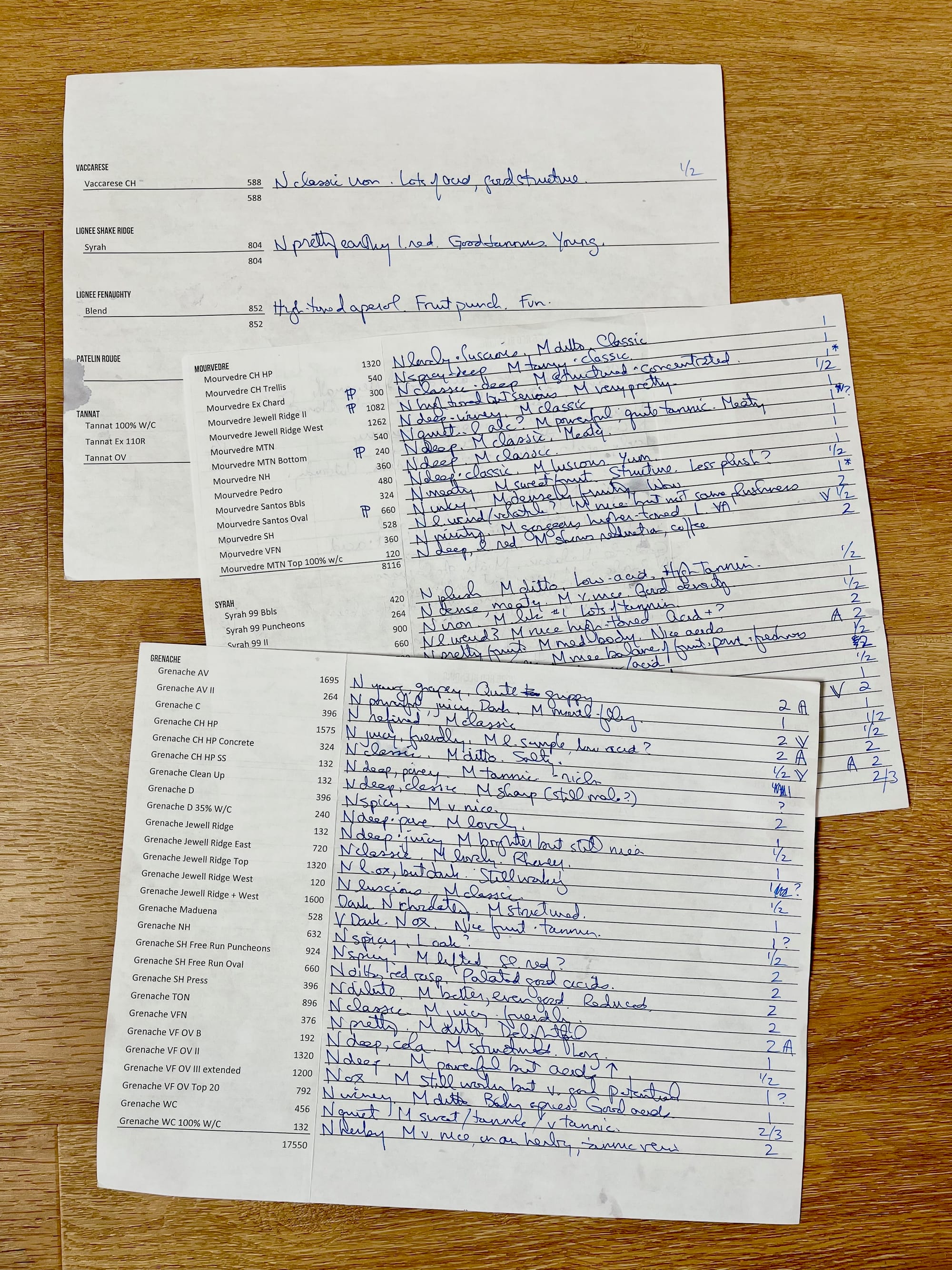
I’ll share my overall impressions of each grape in the order in which we tasted them, so you can follow the evolution of our own thinking.
- Grenache (27 lots): Grenache as usual offered the most variety, as it can range from a pale, spicy profile more like Counoise to the darker-fruited, plusher licorice character often found in the Rhone. I gave ten lots "1" grades, five others "1/2" grades, ten "2"s, many of which will be perfect for (spoiler alert) our expanded production of Alouette and one lone "2/3" lot.
- Vaccarese (1 lot): We only had one Vaccarese lot this year, but it was classic, with an iron-like minerality and good acids and structure. I gave it a “1/2”
- Tannat (3 lots): Between the 2024 and 2025 vintages we grafted over one of our three Tannat blocks to Clairette Blanche and Picardan, so we had fewer lots. All were dense and powerful, with plentiful fruit and ample structure. I flagged one favorite lot (which we happened to ferment with whole clusters, and which I felt gave a little more elegance) for inclusion in our En Gobelet blending, but didn’t otherwise give the lots grades. Combined, they should make a dramatic, long-lived varietal Tannat.
I’ll report later on the (already-blended) lots that will go into Patelin de Tablas and Lignée de Tablas programs here, but they were strong. Still, I don’t think any of us had a clear sense of a narrative for the year at this point. But that narrative built as we made our way through day 2:
- Cinsaut (3 lots): The three lots of Cinsaut were all quite different. My favorite was plush and deep, with an intense purple color unusual for this often-paler grape. I gave it a “1” and noted that it was so impressive that we might consider it for Panoplie. The second lot was pure and lovely, more translucent with lovely spice and acids. I gave it a “1/2”. A third (small) lot had a little volatility on the nose, and I gave it a “2/3”.
- Counoise (11 lots): A gorgeous year for Counoise. Two lots (which coincidentally and happily were our two largest lots, representing about 40% of the total volume) had both Counoise’s characteristic bright, spicy fruit and also an extra layer of lushness. I gave these “1” grades. Five other lots were a little less intense but had lots of the pretty, spicy Gamay-style juiciness that our varietal Counoise bottling typically reflects. I gave them all "1/2" grades. The other four lots got “2” grades from me, though they’ll all be great components of blends.
- Muscardin (1 lot): Our best Muscardin yet. Complex and herbal on the nose, with high-toned red fruit and bright acids. I gave it a “1/2" and we decided that it was worth (for the first time) including in trials for the Esprit de Tablas.
- Terret Noir (1 lot): Not my favorite Terret Noir showing. I found it tannic but a little thin, without a lot of fruit and also without the intensely herby character we got from our first few vintages of Terret. I gave it a "2/3" and we decided that it wasn’t worth making a varietal bottling this year. We’d use what we needed for the Le Complice and the rest would go into an Alouette.
- Pinot Noir (2 lots): Like the Tannat, there wasn’t a reason to give these lots grades, but I liked them both. One was fermented with whole clusters and had nice herbiness and lift, while the other showed plusher, with more oak. They’ll become a lovely Full Circle Pinot Noir.
- Cabernet (1 lot): Our tiny lot of Cabernet has to be really good to get our attention. This one was, with a characteristic eucalyptus note over dark fruit, and lift that’s rare for Cabernet in California but which we think is a signature of it when it’s grown on limestone. The bar is high, though, for us to bottle a varietal Cabernet, and we weren’t sure if it cleared that. We decided to punt on the decision and try it again in the fall. If not, it will go into our Tannat.
Halfway through day 2, I think it’s fair to say we were getting excited, but still searching for the real standout of the vintage. Then we tasted the Mourvedre:
- Mourvedre (14 lots): This was the best tasting I can remember for Mourvedre. I kept writing notes like “pure” and “deep” and “classic” and “luscious”. Nine of the lots got “1” grades from me. Three others (which in a different year might have been “1”s) got “1/2” grades. Three got “2” grades. And that was it. We had our superstar.
- Syrah (16 lots): Syrah at this stage is typically easy to appreciate, with its mouth-filling dark fruit, spice, and powerful structure. But compared to Mourvedre, the grape felt marked by structure and density, rather than fruit. I only gave out three "1" to lots that had plushness and fruit in addition to their structure and body. Six other lots, all of which I thought were very strong, got “1/2” grades because I was worried they might be too dominant in a blend. Six lots, all of which were a little lighter-bodied but which I felt showed nice balance and approachability, will become the base for our varietal Syrah and (blended with some Counoise) our new Alouette Syrah. And one wine, lighter bodied but with a touch of reduction, got a "2/3".
To summarize, of the 74 estate Rhone-inspired lots we tasted, I gave out 25 "1" grades. 22 others got "1/2"s. That's 64% of the lots that I graded as strong enough for consideration in Esprit or Panoplie. Given that our target quantities of Esprit and Panoplie only make up about 20% of our estate production in a year like 2025, it was clear that we were going to have some terrific lots available for varietal wines, Cotes de Tablas, and more.
We finished the day with our normal round-table discussion about what we wanted to try in the blending of Panoplie and Esprit and decided that given the overall strength of the vintage we should start the blending trials with three test blends, each one leaning a little heavier into one of the big three of Mourvedre, Grenache, and Syrah, and see where that took us. But unlike the past few years, we had enough Mourvedre to really lean hard into that grape in both Panoplie and Esprit. Would it be the right choice to do so? We would see. We also decided to take the blending in stages, answering the main question (which of our core varieties should take the lead, and by how much) first, and then come back to answer some of the secondary questions, like should Cinsaut make its first-ever appearance in Panoplie this year, and should Muscardin make its first appearance in Esprit.
The morning of day three we started with three test blends of Panoplie. As always, we tasted our options blind, not knowing what was in each glass. Panoplie is always overwhelmingly Mourvedre (typically around 60%) and we cap both Syrah and Grenache percentages at no more than about 25%, because Syrah's dominance often threatens to overwhelm the Mourvedre character of the wine, while we’ve learned that too much Grenache brings the wine too close to the character of the Esprit. Because of how good the Mourvedre was, we decided to try a blend that pushed that percentage near 75%, and it was a minor surprise that this blend (73% Mourvedre, 14% Syrah, 13% Grenache) came in last in our first round of trials. Our favorite was one that was 65% Mourvedre, 21% Grenache, and 14% Syrah, followed closely by a blend that essentially reversed those Syrah and Grenache percentages. After some discussion, we decided to try the favorite of our first round against an option that roughly equalized the Syrah and Grenache, and the compromise was a consensus favorite. Final blend: 66% Mourvedre, 18% Syrah, 16% Grenache. Next, we tried that blend against one that included 3% Cinsaut, and felt that even that small addition made the wine a little less luscious, and that the slight additional vibrancy that we gained by doing so wasn’t worth the tradeoff. Sometimes the classics are classics for a reason.
Panoplie decided, we moved on to the Esprit de Tablas, and the blending played out similarly. We tried Mourvedre ranges from 40% to 46%, Syrah ranges from 20% to 27%, and Grenache ranges from 20% to 27%. This time, the group split between the blend that leaned heaviest into Mourvedre (deepest, but a little tannic) and that which leaned heaviest into Grenache (most polished, better minerality, but a little less rich). Again, a second round blend that split the difference proved to be the winner: 44% Mourvedre, 24% Grenache, 21% Syrah, 5% Counoise, 4% Vaccarese, and 2% Cinsaut. When we tried a third round of blending with (and without) the Muscardin added, we split 50-50 around the table, with people all professing some doubts as to whether they could replicate their results. After some discussion, we decided not to include it in the blend. I had three main reasons. First, it was only going to be 1% of the blend. I felt like that small a percentage would feel token. Second, if we’re going to make a pretty major statement by including a new grape in Esprit, I wanted it to be conclusively better, not ambiguous. And finally, with the Muscardin so delicious this year, and still so new and rare, I thought it might be better deployed as a varietal bottling rather than lost in the Esprit. It will only be 35 cases, but sharing those 420 bottles of something new and exciting felt more important than having another grape on the Esprit label.
On day four we tackled the rest of our blends, starting with En Gobelet. Over the last few years, new production off of Jewel Ridge and other new head-trained blocks has given us more options for this wine than ever before, even after using some of our favorite head-trained lots in Esprit and Panoplie. With everything carrying good structure, and Mourvedre playing the superstar, perhaps it was unsurprising that we chose the blend that had the least Tannat and most Mourvedre while still holding on to its essential Grenache-based generosity. And unlike the blends the previous day, we couldn’t think of a tweak we wanted to try in a second round. Final blend: 36% Grenache, 31% Mourvedre, 17% Syrah, 13% Counoise, and 3% Tannat.
For Le Complice, which celebrates the kinship we feel Terret Noir shows with whole cluster Syrah, we had to make a decision on what we liked. Our first blend, with the most Terret Noir (28%), felt the herbiest and highest-toned, interesting but not particularly plush. Our third blend, with the least Terret (9%) and most Grenache (37%), felt the deepest and had the most general appeal. Our second blend, which maxed out our Syrah percentage (62%) and had a middle amount of Terret (18%), satisfied no one. After some discussion, we decided that the more important goal here for us was to maximize the pleasure that the wine brought to people, and chose wine number three. Final blend: 54% Syrah, 37% Grenache, 9% Terret Noir.
With the two wine club blends coming together so quickly, we decided to knock out the blending on the Cotes de Tablas before we wrapped up day 4. Because we had plenty of excellent Grenache and Syrah left, and enough Mourvedre and Counoise, we had more options than usual. So we tried blends with between 44% and 50% Grenache, 18% and 28% Syrah, 13% and 21% Counoise, and 9% and 21% Mourvedre. The first round allowed us to set aside the blend that had the most Syrah, but we split between a tangy, salty, higher-toned blend with more Counoise and Grenache lots and a more mouth-filling, structured option that used the most Mourvedre. We tried both favorites against a blend that split the difference, but this time instead of preferring the compromise it reaffirmed the appeal of the brighter, Grenache-led option. Final blend: 50% Grenache, 21% Counoise, 20% Syrah, and 9% Mourvedre. I think this is the first time that Counoise has ever surpassed the Syrah in the Cotes de Tablas, and it’s probably not surprising that it would happen in this powerful year. A (comparatively) little Syrah went a long way.
We knew, after seeing the incredibly plentiful Grenache harvest, that we would have the opportunity to make a significantly increased production of Alouette. We feel good about this decision for two reasons. First, the category of chillable reds is one of the categories showing the most growth around the country. Second, we've been looking for an opportunity to get one or two of our (ROC- and CCOF Organic-certified) estate wines in broader distribution. The impact in the market of environmental certifications has never been higher, and while the Patelin vineyards have all been farmed organically since at least 2024, they're not all certified, so we can't put a seal or mention that on the label. But on Alouette, which is all from our estate, we can.
So throughout the component tasting of the Grenache, we were looking for lots that would be right for Alouette. My goal was to make 3,000 cases, a big jump from the ~700 cases we made in 2024, and because even the lighter Grenache lots tend to be around 14.5% alcohol, to incorporate some of the appropriate lots of other grapes to bring the alcohol down to around 13.5%. We ended up with a lovely blend that was 78% Grenache, 16% Mourvedre, 4% Terret Noir, 1% Counoise, and 1% Cinsaut. As it turned out, even after making this expanded production of Alouette, we still have more Grenache than I think we should bottle. We’ll be looking for opportunities regarding that!
I also have been eyeing Syrah as a category which was ripe for someone to bring new life to in the wholesale market. I wasn’t sure if we’d be able to find enough lots to make 1,000 cases of an Alouette-style Syrah, but had it in my back pocket as an idea depending on what we needed in our blends. As it turned out, the inherent structure of the year meant we didn’t need higher-than-usual quantities of Syrah to bring density to our blends. So, after looking at what we’d tasted, it seemed clear to us that we would be able to make the Alouette Syrah. But how to differentiate it from our estate Syrah? The answer, as it is to many things in our world, is blending. We’ve always loved how Counoise complements Syrah. It has some of the same herby lift, but with brighter fruit, open-knit structure, and bright acids. Including 22% Counoise along with the brightest 78% of our Syrah seems like it will make something still recognizable as Syrah but fresh, juicy, and appealing. And that was what we did. I’m excited to see what people think.
Those decisions made, we dedicated day five to tasting the full lineup of blends and varietal wines, as well as the non-estate wines like Patelin de Tablas and Lignée de Tablas. It's important for us to make sure everything is properly differentiated. We don't want, for example, a Grenache-dominated wine like Cotes de Tablas to taste too much like our varietal Grenache, or the Esprit and Panoplie, both of which are based on Mourvedre, to feel too close to each other or our varietal Mourvedre. We also were looking forward to tasting our growing lineup of Syrah-based wines: the estate Syrah, our Alouette Syrah, the Lignée de Tablas Shake Ridge Syrah, and the Patelin de Tablas.
My quick notes on each of the twenty wines we made, and their rough quantities:
- Alouette Grenache (3225 cases): A pretty, vibrant pale red. The nose is juicy and delightful, with aromas of chaparral, yellow plum, and sweet baking spices. On the palate, plum and dusty wild strawberry notes, complete with fruit, leaves, and flowers. The finish is juicy with refreshing acids and just a little tannic grip. Delicious.
- Grenache (2400 cases): A spicy, minty nose with redcurrant and elderberry fruit and a little milk chocolate. The mouth shows pure dark cherry fruit with baking spice and rose petal nuances, and a long finish with some youthful spicy tannic grip.
- Cotes de Tablas (1530 cases): Both charming and serious on the nose with aromas of black raspberry, cracked pepper, and a little leathery meatiness. On the palate, lots of cherry and black plum fruit, sweet spices, and a nice mineral saltiness on the finish with lingering violet florality.
- Lignée de Tablas Fenaughty Vineyard (330 cases): This blend of 57% Grenache, 39% Mourvedre, and 4% Terret Noir showed a cool, minty nose of red cherry and juniper. The mouth was similarly alpine with tangy blood orange and watermelon rind fruit, fine-grained tannins, and a long finish. Elegant but in no way simple.
- Alouette Syrah (1000 cases): A bright nose of blackberry pie and sarsaparilla, cocoa powder and chalky mineral. On the palate, tangy black fruit, a little minty lift, and lingering chalky minerality. No oak. Beautifully fresh, and a wine to convert people who don’t think they love Syrah.
- Syrah (875 cases): A deep, brooding nose of black licorice, baker’s chocolate, teriyaki, and a little minty lift. The mouth shows chocolate-covered blueberry, marzipan, and forest floor notes, with chalky, chewy tannins and a long finish. Classic and should be very ageworthy.
- Patelin de Tablas (3700 cases): A polished nose of black pepper, blackberry, and crushed rock speaks to its Syrah lead, while the palate shows black raspberry and cherry cola notes, with a little lifted strawberry hinting at its Grenache component. The finish is clean with black fruit, sweet spice, and polished tannins. Final blend: 41% Syrah, 34% Grenache, 22% Mourvedre, and 3% Counoise.
- Lignée de Tablas Shake Ridge Syrah (310 cases): A deep, warming nose of root beer and warm earth, fig and baking spices, in which I feel like I can taste the high iron content of the soil there. The mouth has flavors of brown bread, sweet spices, and moderate tannins. Like black raspberry jam on homemade bread. Lovely and quite different from our estate Syrah.
- Muscardin (35 cases): A gorgeous nose of cherry pastille, menthol, crushed herbs, and potpourri. The mouth shows crystalline purity with flavors of cranberry and pomegranate, salty minerals, and a thyme-like herby finish.
- Full Circle (235 cases): A powerful nose of black cherry, sweet oak, and mineral. The mouth is dense and not particularly giving at the moment, showing more oak than fruit. The finish opens back up with flavors of molasses and plum compote. This is a serious Pinot that we’re going to put back into (neutral) barrels to let the oak component integrate, and will be bottling later than we often do. But it should be glorious once it all comes together, one of our most ageworthy Full Circle Pinots in our history.
- Cabernet Sauvignon (50 cases, maybe): A nose of eucalyptus, black olive, red fruit, and green herbs. The mouth is medium-bodied, with flavors of pipe tobacco, plum, and a lovely graphite minerality. The good acids we noted in the component tasting come out on the finish, leaving a lingering impression of green herbs.
- Tannat (750 cases): A powerful nose of black cherry, teriyaki marinade, and cured meat. The palate shows chocolate-covered cherry fruit, substantial tannins, bright acids, and a lingering finish of meat drippings and cracked peppercorns.
- Counoise (425 cases): A nose of minty cranberry, pink peppercorn, and sweet baking spices. The mouth is on point with crisp red raspberry and rhubarb fruit, green herbs, chalky minerals, and a red apple skin note that comes out on the refreshing finish.
- Cinsaut (175 cases): A serious nose both meaty and fruity, like duck breast with blueberry reduction and cracked pepper. The mouth is powerful with flavors of cherry candy and cola, wild roses, and a finish like strawberry pie, complete with fruit and buttery crust.
- Vaccarese (100 cases): A nose of iron and blueberry, menthol, and licorice root. On the palate, notes of tart blackberry, plum pit, powdered chocolate, and crushed rocks. The finish is vibrant with salty black raspberry fruit and some iron-like tannic grip.
- Mourvedre (575 cases): An inviting nose of redcurrant, new leather, warm earth and jasmine tea. The mouth is equally appealing, with flavors of cassis, cocoa powder, meat drippings, and sweet spice. The finish is like a warm hug, with leather, mint, and red fruit notes lingering.
- En Gobelet (750 cases): A meaty, spicy nose showing both red and blackcurrant fruit, chaparral, hibiscus, and anise. The mouth is vibrantly red fruited with salted plum and sarsaparilla notes, tangy acids, and good lushness. The finish shows mineral lift and a lingering impression of warm oak leaves, like an autumn walk in the woods.
- Le Complice (260 cases): A nose of blackberry jam and green peppercorn speaks powerfully of Syrah. On the palate, lushly black fruited with salted blackberry and sweet green herbs. The finish shows a pretty cinnamon stick note and meatiness like roasted lamb with an herb rub.
- Esprit de Tablas (2800 cases): A deep, inviting nose with notes of meat drippings, milk chocolate, plum, bay leaf, cracked pepper, and foresty earth. The mouth is gorgeous: deeply fruited with cassis and black plum, red and black licorice, new leather, and sweet spices. The finish shows notes of black tea and warm earth and lingering tannins. Serious but still approachable, and seemingly an Esprit that will be appealing both upon release and with time in the cellar.
- Panoplie (700 cases): A rich, luscious nose of chocolate-covered cherry, tangy teriyaki, and garrigue. The mouth shows both purity and density, with flavors of cassis, pepper-crusted ribeye, hoisin, and chalky tannins. The finish shows licorice, crushed rock, and a salted candied rose petal note that was beguiling.
A few concluding thoughts.
- I asked the team around the table to describe the vintage, and wanted to share what they had to say. Chelsea said, “It was powerfully structured and chewy, even on varieties you wouldn’t expect.” Gustavo added, “Yes, with a lot of salinity and minerality.” Austin commented, “Nothing feels docile; they’ve all got liveliness. Nothing feels weighed down by its depth.” And Craig summed it up: “It’s the year of Mourvedre and Roussanne.”
- In terms of vintage comps, I feel like this was a hybrid of the darkness that we saw in 2023 and the power we saw in 2019. It also reminded me of our 2007 vintage. We haven’t had a cool, dry year in a while, so you have to go back to the 2000s to find a weather comp, and our vineyard is in such a different place than it was then, approaching 30 years old and with a much wider range of grapes. Still, the fact that the fruit was so dark and the textures so rich reminded me of several of our best vintages. I have a feeling that however it plays out, we’re going to be happy. [Note, if you'd like to dive into a more comprehensive list of vintage comps, check out my 2022 blog post diving into vintage character.]
- The concentration of the vintage wasn’t a function of scarcity. The increase in both tons per acre (up 27.8% from 2.37 to 3.03) and gallons per ton (up 8.8% from 143 gallons per ton in 2024 to 155 gallons per ton in 2025) meant that we had 39% more wine to work with. But more and more I’m coming to believe that optimal quality doesn’t come from the years when the vines are under the most stress. Look, for example, at how good the years where we’ve gotten great rain have been. Those years (recently) have included 2017, 2019, and 2023, and all those years saw above-average yields. Years that were dry and hot, like 2020 and 2022, were more challenging. Because it’s been so long since we had a year like 2025, with its combination of cooler-than-normal and drier-than-normal, we don’t have a lot of recent experience to lean on. But seeing that both tons per acre and yields per ton were right at what we consider optimal suggests that the grapevines finished the harvest in good shape, and the longer, slower ripening seems to have protected them from some of the stress-related issues we see in hotter years.
- That additional quantity is largely going into our Alouette Grenache and Alouette Syrah. Still, I was excited that we have better quantities (and exceptional quality) of several of our more traditional varietal reds. Having 175 cases of Cinsaut, 425 cases of Counoise, or 575 cases of Mourvedre may not sound like a lot, but it’s better than we’ve been able to make in most recent years. And they’re all so, so good, mostly from “1” and “1/2” rated lots. On the flip side, even after making the higher quantity of Alouette and using healthy amounts of Grenache in all our blends, we are still left with over 2,000 cases of wine that’s perfect for a varietal Grenache. The only problem… I’m not sure we can sell that amount of Grenache, at least not without working so hard at it that it will compromise other efforts. If you run a restaurant wine program and have been looking for a private label Grenache bottling, please reach out!
- As in most of our recent years, we generally loved the lots that came from younger heard-trained, dry-farmed blocks like Jewel Ridge. But this year, outstanding lots came from all over the property. For example, the lots that we chose for Panoplie, typically the best of the best, consisted of four Mourvedre lots and two each of Grenache and Syrah. Those Mourvedre selections included our youngest Mourvedre block (a trellised block we call the Santos Block after our Santos Espinoza, our late and much-missed Assistant Nursery Manager) and our oldest (Mount Mourvedre) as well as a Jewel Ridge block and a block that we often haven’t loved, from a 2011 graft onto the trunks of some Chardonnay vines planted in 1997. The Grenache selections included one Jewel Ridge lot and one from a trellised block planted in 1995. And the Syrah selections included our oldest Syrah, from 1992, and our youngest, from an experimental vineyard block we’ve planted to alternating rows of Syrah and Grenache just in 2022. I guess that’s a testament to what happens in a great year, as well as the work on vineyard health that Austin, Erin, and Neil have been overseeing.
I'll let Neil, who wasn’t able to join us for the blending because of a recent surgery but got a chance to taste the wines after, have the last word: "Overall impression is a strong vintage. Very consistent. Lots of weight but will need some time to relax. All in all a great display of wines showing a strong sense of Tablas Creek with great backbone and structure."