
Blending the 2025 white wines: a vintage of lushness and lift produces a full lineup of varietal whites for the first time since 2021
We welcomed Francois and Matthieu Perrin last week for three days spent around our blending table, working to turn the 43 different estate lots we made from our white grapes in 2025 into the blends and varietal bottlings we'll be releasing to you in coming months.
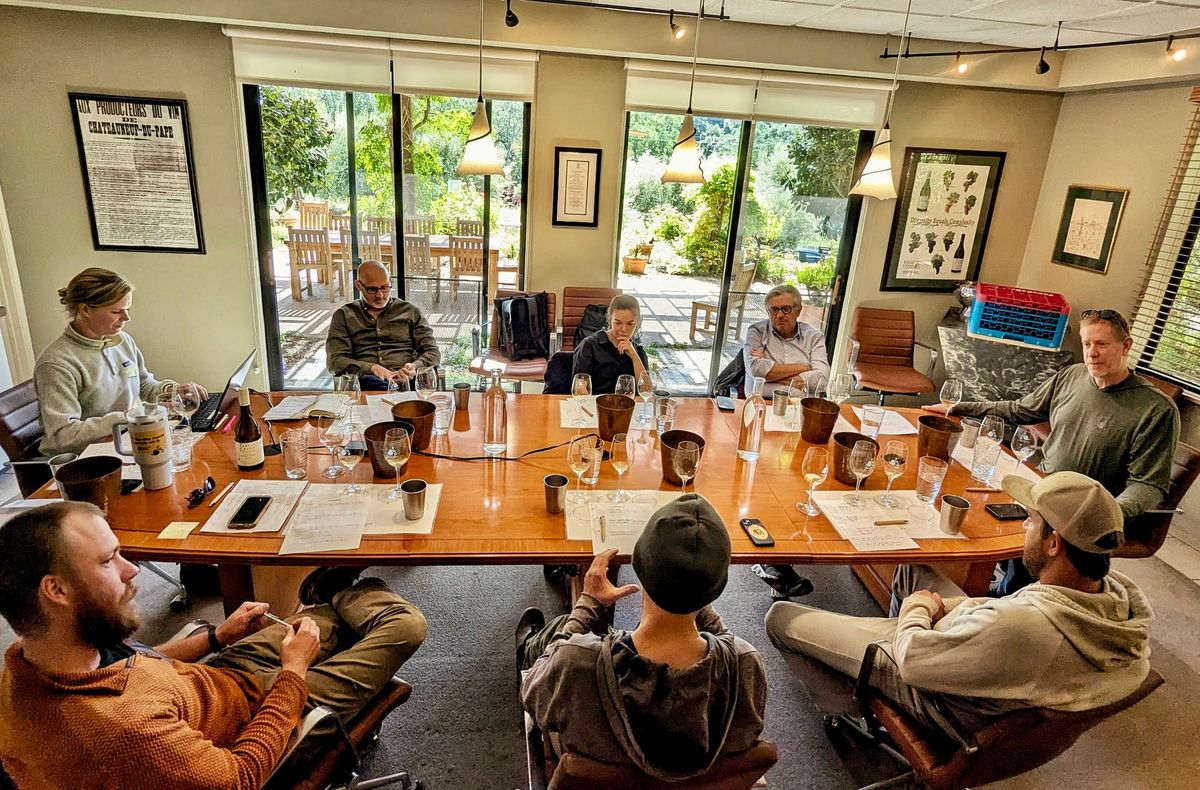
We welcomed Francois and Matthieu Perrin last week for three days spent around our blending table, working to turn the 43 different estate lots we made from our white grapes in 2025 into the blends and varietal bottlings we'll be releasing to you in coming months. I think it's fair to say that we left the blending table thoroughly excited about the vintage. We saw outstanding quality across the board, with both power and freshness. We also saw the impact of the improved yields in 2025, which allowed us to make all the blends we count on (including our second-ever Panoplie Blanc) as well as a complete lineup of varietal bottlings for the first time since the 2021 vintage. What did we make? And how did we decide what to put into the blends we'll be bottling over the coming year? Read on.
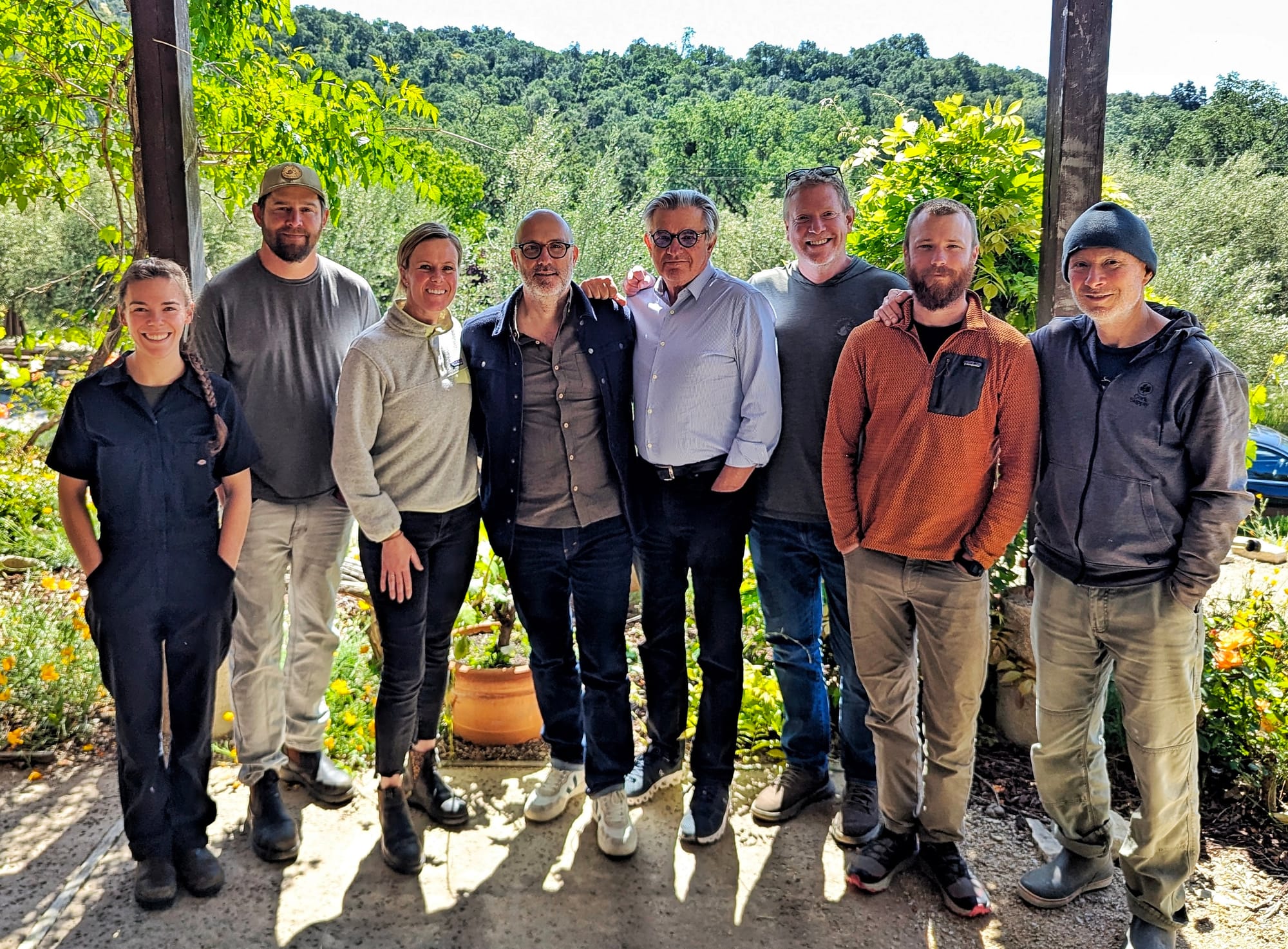
If you're unfamiliar with how we do our blending, you might find it interesting to read this blog by Chelsea that she wrote a few years ago. The big difference this year was that after several years of coming for our red blending week, this year we thought it would be fun to have the Perrins be a part of white blending. We always learn things from their presence, and it seemed like it was fun for them to dive into some of the rarer grapes. After all, even at Beaucastel, they don't typically have enough of grapes like Picardan, Bourboulenc, Clairette, and Picpoul to ferment on their own. The team:
Our first step was to taste each variety in flights, give each lot a grade, and start assessing the character of the year. Our grading system is simple; a "1" grade means the lot has the richness, elegance, and balance to be worthy of consideration for Esprit Blanc. A "2" grade means we like it, but it doesn't seem like Esprit, for whatever reason. It may be pretty, but without the concentration for a reserve-level wine. It might be so powerful we feel it won't blend well. Or it might just be out of the style we want for the Esprit, such as with too much new oak. A "3" grade means the lot has issues that need attention. It might be oxidized or reduced. It might still be fermenting and in a place that makes it hard to evaluate confidently. Or it might just not have the substance for us to be confident we'll want to use it. Most "3" lots resolve into 2's or 1's with some attention. If they don't, they end up getting declassified. Then, we start from the top of our hierarchy and brainstorm possible blends, taste those blind against one another, and come to consensus. Once we've determined the blend and quantity for the wine at the top of our hierarchy, we set aside the lots that wine uses and look at what we have left for the next wine, and so on down the line. Finally, we taste everything we're going to make to be sure that each feels complete and individual. A snapshot of my notes highlights just how many 1's there were this year, and how few 3's:
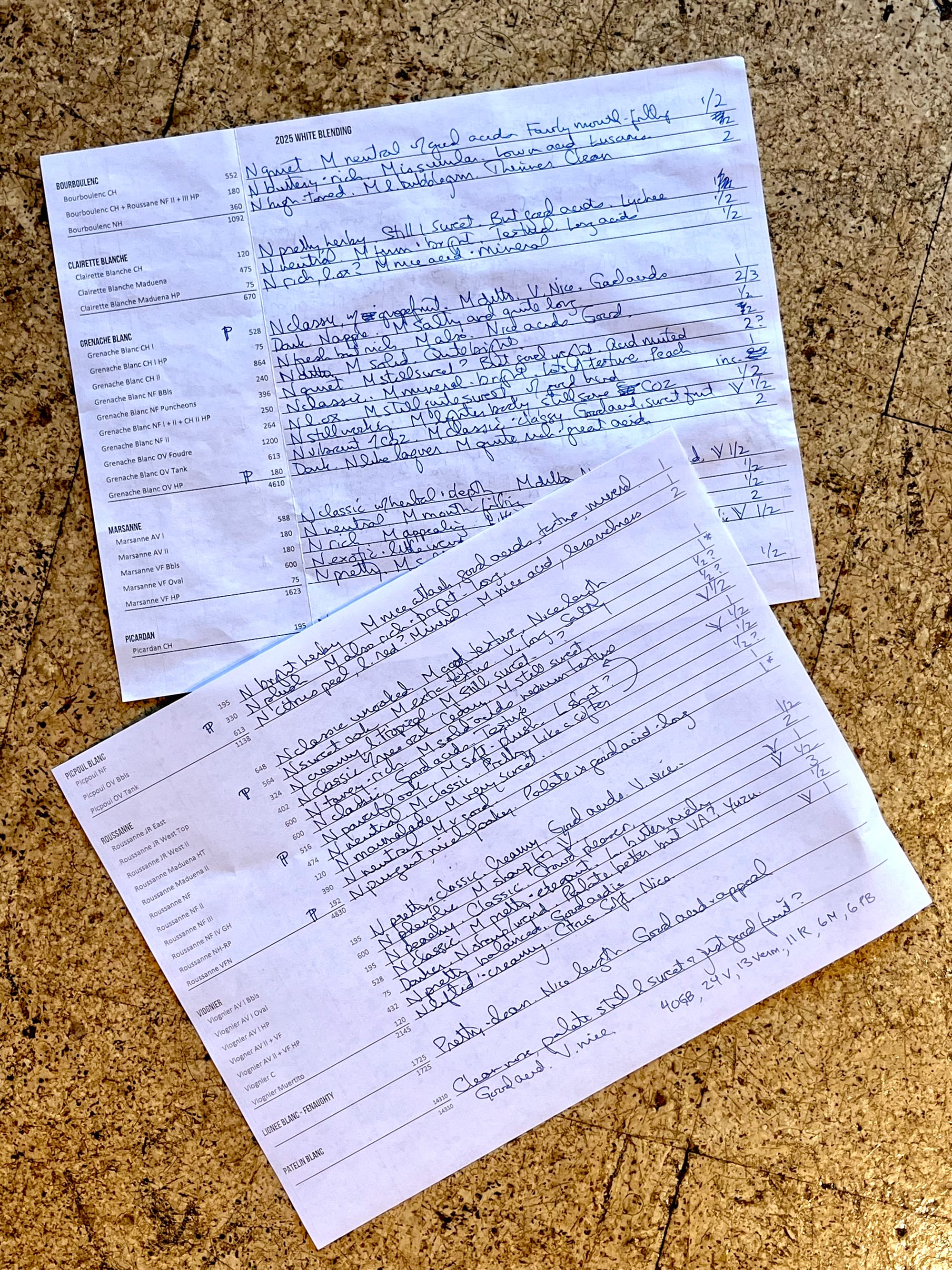
The first of the three days we spent diving into the component lots. My quick thoughts on each variety are below. For context, in a normal year, for every 10 lots we might see three or four "1" grades, five or six "2" grades and one "3" grade. When we think a lot is right on the cusp between two grades, we can note that with a slash ("1/2", or "2/3"). As you'll see, in this year, more than half our lots got "1" grades from me and there was only one lot that I gave a single "3" to. It was interesting to note that the lots with the most variability were the ones we harvested earliest, while the later-harvested varieties were more uniformly outstanding. In rough harvest order:
- Viognier (7 lots): A very good Viognier vintage, with good richness, better-than-usual acids, and a little more of the classic apricot and jasmine exuberance that makes it one of the most distinctive of the Rhone whites. I awarded two lots "1" grades, three others "1/2"s, one "2", and to one single-barrel heavy-press lot that I found a little volatile, the day's only "3".
- Grenache Blanc (10 lots): As is often the case with Grenache Blanc, which can take a long time to finish fermenting, this was the grape where there was the most variability. There was good richness and good brightness across the board, but there were also a couple of lots that were still sweet and a couple of others that had just finished fermentation. The best lots had purity and pithy citrus flavors alongside rich texture. Others were a little heavier, leaning more toward a bruised apple, slightly oxidized character that happens toward the end of fermentation, though even those had good acids and I'm confident that with some attention from the cellar they'll be great. I gave two lots "1" grades, three others "1/2"s, one "2", one single-barrel heavy-press lot whose oxidative character was a little stronger than the others a "2/3", and two lots that were still sweet enough to be hard to place "incomplete" grades.
- Marsanne (5 lots): An outstanding Marsanne vintage. As we don't put Marsanne (as it isn't a Chateauneuf-du-Pape grape) in the Esprit de Tablas Blanc or Panoplie Blanc, I didn't give anything a "1" grade, but I gave 4 of the 5 lots "1/2"s. One lot that was still finishing fermentation got a "2" from me. All the lots showed Marsanne’s classic combination of gentle honeyed flavors, creamy textures, and a little minty lift that provided focus.
- Picardan (1 lot): Our lone Picardan lot showed nice brightness and a pretty note of sweet green herbs. I gave it a "1/2".
- Bourboulenc (3 lots): The three lots of Bourboulenc each had their own character. My favorite, to which I gave a "1/2", had the grape's signature bright preserved-lemon acids and a rich, nutty texture. The other two lots, to which I gave "2" grades, split in personality, with one leaning more into the rich, luscious texture but being a little low in acid, while the other was high-toned and clean, but with a little less weight.
- Clairette Blanche (3 lots): I was pleased by how our Clairette Blanche showed. We got a new block in production, roughly tripling our quantity compared to last year, and even in its first year I gave both lots from that block "1/2" grades, as they were classic Clairette with smooth texture, bright acids, and nice crushed-rock minerality. Our lot from our oldest block added to that a pretty sweet green herb character and earned a "1" grade from me.
- Picpoul Blanc (3 lots): I loved how our Picpoul showed this year. Two lots had the classic pineapple flavors, mineral notes, bright acids and mouth-filling texture we love from Picpoul, and got "1" grades from me. The third I liked a lot as well, but was a little less rich. I gave that a "2".
- Roussanne (11 lots): What a pleasure to have a year where Roussanne was both outstanding and (relatively) plentiful. The wines all showed texture, richness, and the typical honey and green herb character we love in Roussanne. They all also had at least solid acidity, which we don't often get. Some had more sweet oak character, some less, but in all cases it felt integrated and appropriate. There were three lots that were still sweet enough that it was hard to give a final grade, but all seemed to have such good potential that I gave them "1/2" grades nonetheless. Otherwise I gave five "1" grades and three "1/2" grades, just to differentiate lots that felt more like they should be aimed at our varietal Roussanne bottling rather than Panoplie Blanc or Esprit Blanc.
For the Panoplie Blanc, we want to lean into lushness. In the same way that we differentiate our Mourvedre-led but not Mourvedre-dominated Esprit de Tablas from our Panoplie by increasing Panoplie's target percentage of Mourvedre to around 70%, we want Panoplie Blanc to celebrate Roussanne, rounded and deepened by a touch of oak, and make a wine that is luscious, textured, ageworthy, and memorable. By contrast, Esprit Blanc, while still based on Roussanne's rich texture and honey flavors, will lean a little more into the freshness of the full range of Chateauneuf-du-Pape white grapes.
For the Panoplie Blanc, we identified three lots of Roussanne, two of Grenache Blanc, and one of Picpoul Blanc that we thought had the requisite character and intensity. As usual in a three-variety blend, we decided to start our blending process by making three test blends and having each one lean a little heavier into one of the three grapes to see what we learned. As sometimes happens, we had a clear consensus in the first round. The blend that leaned heaviest into the brighter grapes (with 27% Grenache Blanc and 19% Picpoul) was lovely but felt more like Esprit Blanc than Panoplie Blanc. The lot that reduced Picpoul to 5% and kept 25% Grenache Blanc (with 70% Roussanne) was powerful and structured, would be ageworthy, but was a little less charming than our favorite, which increased Roussanne to 74% along with 20% Grenache Blanc and 6% Picpoul. Our favorite was luscious and long, with a lovely honeyed sweetness (though the wine was dry) and an appealing kiss of sweet oak. It should only get better with another year in barrel.
That decided, we moved on to Esprit Blanc. The new blocks of Roussanne from Jewel Ridge allowed us to both make a little more Esprit Blanc (more like 2200 cases than the 1800 we've been capped at in recent years) and also allowed us to consider Roussanne percentages around 50%, where in recent years we were capped at more like 40% of the grape. So we tried three blends with between 40% and 51% Roussanne, between 20% and 30% Grenache Blanc, between 12% and 17% Picpoul, and between 6% and 12% Bourboulenc. Given the grapes' scarcity and the fact that we wanted to preserve enough for varietal bottlings, we capped Picardan and Clairette at 4% each.
I loved all three options. The one that leaned into Grenache Blanc (in our first glass) had lovely sweet kiwi character and honeysuckle florality, along with mouth-watering acids and salty minerals. It was my favorite. The one that maxed out Roussanne (in our second glass) was refined and textured, with beeswax and lanolin character and great length. The one that split the difference (in the third glass) was polished and structured, with lots of Roussanne character and good acids. The group split between the first and third options, feeling that the second, while delicious, was a little too one-note and maybe too similar in character to the Panoplie Blanc. In the end, we decided to re-taste blends one and three alongside the Panoplie Blanc and came to a pretty strong consensus around the first option. It felt the most appealing and most mineral, while still having plenty of fruit and texture. Final blend: 40% Roussanne, 30% Grenache Blanc, 13% Picpoul Blanc, 12% Bourboulenc, 3% Clairette Blanche, and 2% Picardan.
Happily, after making the Panoplie Blanc and Esprit Blanc, it was clear that we were going to have enough to make varietal bottlings of all our whites, and still have great options for Cotes de Tablas Blanc. The Cotes Blanc is always led by Viognier, but the right secondary grape depends on the vintage. If the year naturally produces lushness but is low in acid, we've found Grenache Blanc critical. If it's got lushness and acid, Marsanne's elegance is usually the right secondary partner. If it's a year which is less lush, then leaning into Viognier even more helps address that. This year seemed to have lushness, acidity, and elegance, so we weren't sure, and decided to try three blends, each leaning into two of the grapes and reducing a third. All three glasses were lovely. The first glass (where we used between 33% and 27% of Viognier, Marsanne, and Grenache Blanc) had beautiful sweet fruit and great length, with an appealing pithy bite on the finish. The second glass (where we increased Viognier to 48% and Grenache Blanc to 32% while including just 5% Marsanne) was the longest, with the most texture and brightest acids, but less fruity. The third (where we used 45% Viognier, 30% Marsanne, and only 15% Grenache Blanc) was polished and substantial with great length and a clean finish. The group split pretty evenly between the first and last glasses, and we realized that there was one variable we hadn't discussed. The first glass included 10% Roussanne and no Clairette Blanche, while the third glass switched those ratios. Wondering if we might get a little more honeyed lushness into the last glass by adding a little Roussanne, we tried using the last wine's base of the three main grapes with 5% each of Clairette and Roussanne, and got to a consensus favorite. Final blend: 47% Viognier, 29% Marsanne, 14% Grenache Blanc, 5% Clairette Blanche, 5% Roussanne.
Making the quantities we did of the blends meant we could make at least a little of all the varietal wines, which was a goal I had. So on Friday we were able to gather to taste the three estate blends, the eight estate varietal wines, as well as the Patelin de Tablas Blanc and the one Lignée de Tablas white that we made: a blend of Marsanne, Grenache Blanc, Bourboulenc, Vermentino, Clairette, and Picardan from the Fenaughty Vineyard in the El Dorado AVA in the Sierra Foothills. A snapshot I took of the wines is below:
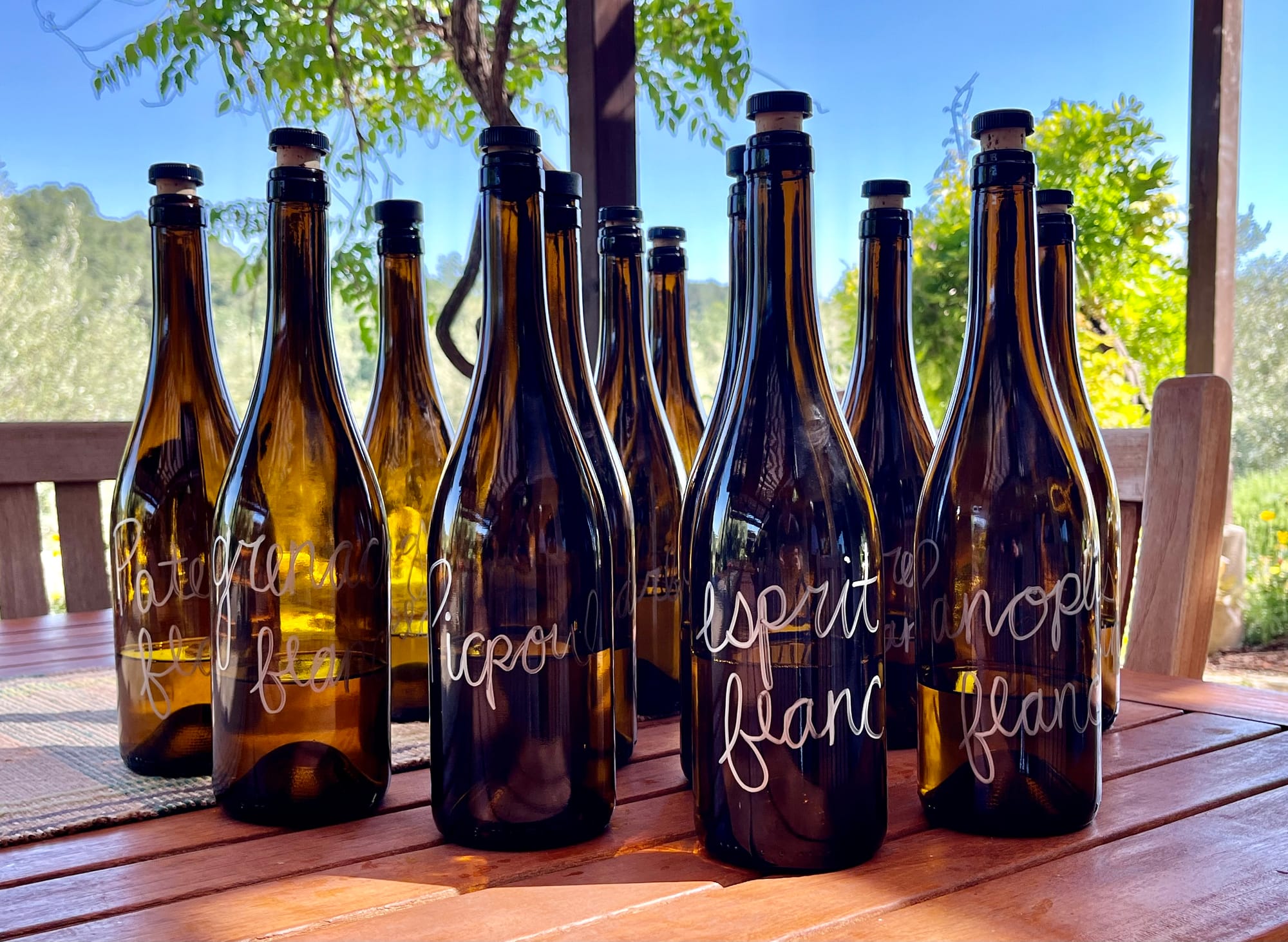
My brief notes on each wine are below, with the rough quantity we'll be bottling between now and the end of the year:
- 2025 Picardan (50 cases): A clean mineral nose, lightly lime leaf, with a little pithy lift. The mouth is clean and fresh with key lime and white grapefruit notes and a finish that shows salty minerality and citrus fruit. Pretty.
- 2025 Clairette Blanche (160 cases): A nose with both tropical (green mango and lemongrass) and chalky mineral elements. On the palate, salted lemon with bright acids and smooth texture. Somehow both mouth-filling and mouth-watering. I'm excited to have enough of this to show to a slightly larger audience.
- 2025 Bourboulenc (100 cases): A spicy nose of almond, cocoa butter, and lanolin. The mouth is rich but bright too, with grilled lemon and nectarine fruit and a salty, nutty finish. A richer take on Bourboulenc than our last version in 2023, more reminiscent of the Rhone examples I've tried.
- 2025 Picpoul Blanc (130 cases): A classic piña colada take on Picpoul, with a nose of pineapple core, lemongrass, and sea spray minerality. The mouth shows more pineapple notes along with preserved lemon and saline elements. Substantial and serious, but still bright. A wine to confound anyone who thinks Picpoul can't be more than a simple pleasure.
- 2025 Grenache Blanc (960 cases): The least polished nose of any of the wines, still impacted by the lots that are finishing fermentation in the caramel apple and toasted marshmallow notes that carry a hint of oxidation. The palate is already in a good place, with notes of fresh apple cider, Key lime, and a little pithy bite like citrus leaf. This will be quite different by the time it's done and bottled but all the pieces are there for an exciting Grenache Blanc.
- 2025 Marsanne (490 cases): A pretty nose of honeydew melon, elderflower liqueur, and citrus blossom, with a little minty lift. The palate shows notes of fresh pear and sweet green herbs with a little salty minerality coming out on the long, clean finish. Lovely. I asked Francois what notes he had on the wine and he said "I'll take 12 bottles".
- 2025 Viognier (600 cases): A gorgeous, exuberant nose of ripe apricot, jasmine, and sweet green herbs. The palate is mouth-filling with apricot and nectarine flavors, great acids for Viognier, and a little minty lift. I'd been wanting a little more characteristic Viognier lushness out of our varietal bottling, and I think this hits that mark without becoming soft or heavy.
- 2025 Roussanne (700 cases): An appealing nose of fresh honey, cinnamon apple, tarragon, and white flowers. The palate still showed a little residual sugar that will be gone long before this is bottled, along with flavors of creme brulee, candied orange peel, and lacquered wood. The finish is long and smooth with notes of salted caramel.
- 2025 Patelin de Tablas Blanc (5700 cases, some of which will be diverted to boxes and kegs): A pretty nose of ripe peach, coconut, sarsaparilla, and broken rock. On the palate, open and lovely, with flavors of red delicious apple, white grapefruit, and nectarine, bright pithy acids and chalky minerals, with a little saline note coming out on the finish.
- 2025 Lignée de Tablas Fenaughty Vineyard (675 cases): A nose of kiwi, finger lime, and sea spray, lifted and appealing. On the palate, somewhere between a (dry) lemon-lime soda and a wonderful gin & tonic, with citrus and juniper flavors, medium body, and plenty of rocky minerality. The finish showed an alpine coolness that felt totally appropriate to the wine's terroir. 49% Marsanne, 25% Grenache Blanc, 9% Bourboulenc, and 9% Vermentino, 4% Clairette Blanche, 4% Picardan.
- 2025 Cotes de Tablas Blanc (500 cases): A powerful nose of fresh honey, dried apricot, and a little briny mineral. The palate is powerful too, with flavors of candied lemon peel, white peach, and wet stone. Full and rich but with good acids too on the long finish.
- 2025 Esprit de Tablas Blanc (2215 cases): A complex, spicy nose of jasmine, Meyer lemon, new honey, and crushed rock. On the palate, Roussanne's weight and texture with flavors of caramel and lanolin, but brightened by a line of acidity like lime candy and Golden Delicious apple. The wine's texture shines on the long finish, with lively acids framing honey and sweet green herbs.
- 2025 Panoplie Blanc (375 cases): A luscious nose of honey, baking spices, crushed rock, candied almond, and a little kiss of sweet oak. The mouth is rich and dense with powerful vanilla custard, honeycomb, and key lime flavors, then a line of acid turns the wine bright on the finish that contains notes of lemon bar and salted butter.
A few concluding thoughts:
- What a pleasure putting these wines together with Francois' and Matthieu's help. It's been probably a decade since we last had Perrin family members here for our white blending, and we have a few new grapes here since then. It was also fun watching them wrap their heads around these grapes that they rarely if ever vinify on their own. We think of all these Chateauneuf-du-Pape grapes as of a family, but many of them are truly rare there. It's probably changed a little since Harry Karis's seminal Chateauneuf-du-Pape Wine Book was published in 2009, but as of then there wasn't a single white grape that represented even 3% of the appellation's acreage, and a grape like Picardan was so rare that when we planted a half-acre here in 2013 that increased the world's Picardan footprint by 40%. Realizing that the Perrins were spending the week learning about grapes that they provided for us was both validating and very cool.
- A year ago, I mentioned that we desperately needed a productive vintage. With 2025, it appears that we got our wish. We have new blocks of Roussanne, Picpoul, and Clairette in production, and the cool year meant that all the grapes saw better yields of fruit per acre and of gallons per ton of fruit. We use an estimate of 155 gallons per ton. In 2024, the relentless heat at the end of the growing season reduced that to around 130 gallons per ton. This year it bounced back up to 149 gallons per ton. That's a 15% improvement in our production even at the same yields, and yields were up too. Hallelujah.
- Because we always prioritize our flagship blends, much of the impact of lower yields comes on the varietal wines that we make. So it's exciting that we're going to be making our first Picardan and Clairette since 2021, and also bottling Bourboulenc and Picpoul after not being able to do so in the 2024 vintage. Now most of these are still going to be scarce; it's not like 50 cases of Picardan is going to last long. But it will be great to have any after having none for what feels like a long time. If these are wines you're excited about, keep an eye on your emails this summer.
- As for what vintage this year reminded us of, you don't have to go too far back. When we blended the 2023 whites, our take-home note was that the wines all tasted like themselves, only more so. The same was true around the blending table this week. If there was a difference with 2023, it was that there was an extra level of lushness this year, perhaps from the higher percentage of head-trained, dry-farmed lots from the new Jewel Ridge blocks. 2023 but with extra lushness? Sounds pretty good to me.
Now that the blending decisions have been made, we can move forward in getting the wines racked, blended, and given time to settle and integrate. The Patelin Blanc and Lignée de Tablas will be the first to go into bottle, in May. The Viognier, Marsanne, Grenache Blanc, Picpoul Blanc, Bourboulenc, Clairette Blanche, Picardan, and Cotes Blanc will be next, in June. And the Roussanne, Esprit Blanc, and Panoplie Blanc will go into foudre and have another 9 months to evolve before their scheduled December bottling.
We're excited about the variety that 2025 has provided, and that we have some old friends back after a few years off. But mostly we're excited that the wines we made seem like they will stand up proudly next to the best vintages in our history. We can't wait to start sharing them with you.