
Flowering 2026: early, but not quite as much as we'd feared
On April 1st, 2026, we were 34 days ahead of 2025's heat accumulation. But by May 15th we were "just" 20 days ahead. The last six weeks has seen ideal conditions for flowering.
This past weekend was the Paso Robles Wine Festival, the unofficial end to our frost season. For the third consecutive year, it was a picture-perfect day, in the low-80s but breezy, with both winter's below-freezing nights and summer's hundred-degree days feeling comfortably far away. And yet, as recently as 2022, we saw freezes at this time of year that cost us something like 30% of our crop of white grapes. So it's with a big sigh of relief that we've made it through the first and most dangerous quarter of the growing season intact. Not that it was easy, mind you. I asked Austin Collins, our Vineyard Operations Manager, if he'd kept track of how many nights he had to be up starting and monitoring our frost protection system of fans and water, and he responded that he hadn't, because he didn't really want to know. But it was a lot. Typically, when temperatures in the middle of the vineyard (where we have our main weather station) drop below 38°F, it's going to be close enough to freezing in our cold spots that we fire up the system.
March wasn't too intense by this measure, with just 5 days dropping below 38°F. But April was more challenging, with 12 such days. We've had one more in May. But it seems like that's over, which definitely deserves a sigh of relief. We know that not all our neighbors were so lucky.
With the fear of frost (hopefully) in the rear-view mirror, we can turn our attention to happier milestones. Flowering is the second of the four viticultural markers that we use each year as markers: notable reference points that indicate where we are compared to other years. These are, in order:
- Budbreak (typically beginning late March or early April, and lasting three weeks or so)
- Flowering (typically beginning mid-May, lasting a month or so)
- Veraison (typically beginning sometime between mid-July and early August, lasting as much as 6 weeks)
- Harvest (typically beginning late August or early September, lasting two months or so)
This year, with budbreak in the beginning of March, we were ready for very early flowering. And we weren't disappointed. By the middle of April we'd started to see flowers in the top-of-hill blocks of our early grapes, like Grenache. I took the below photo on Jewel Ridge on April 17th:
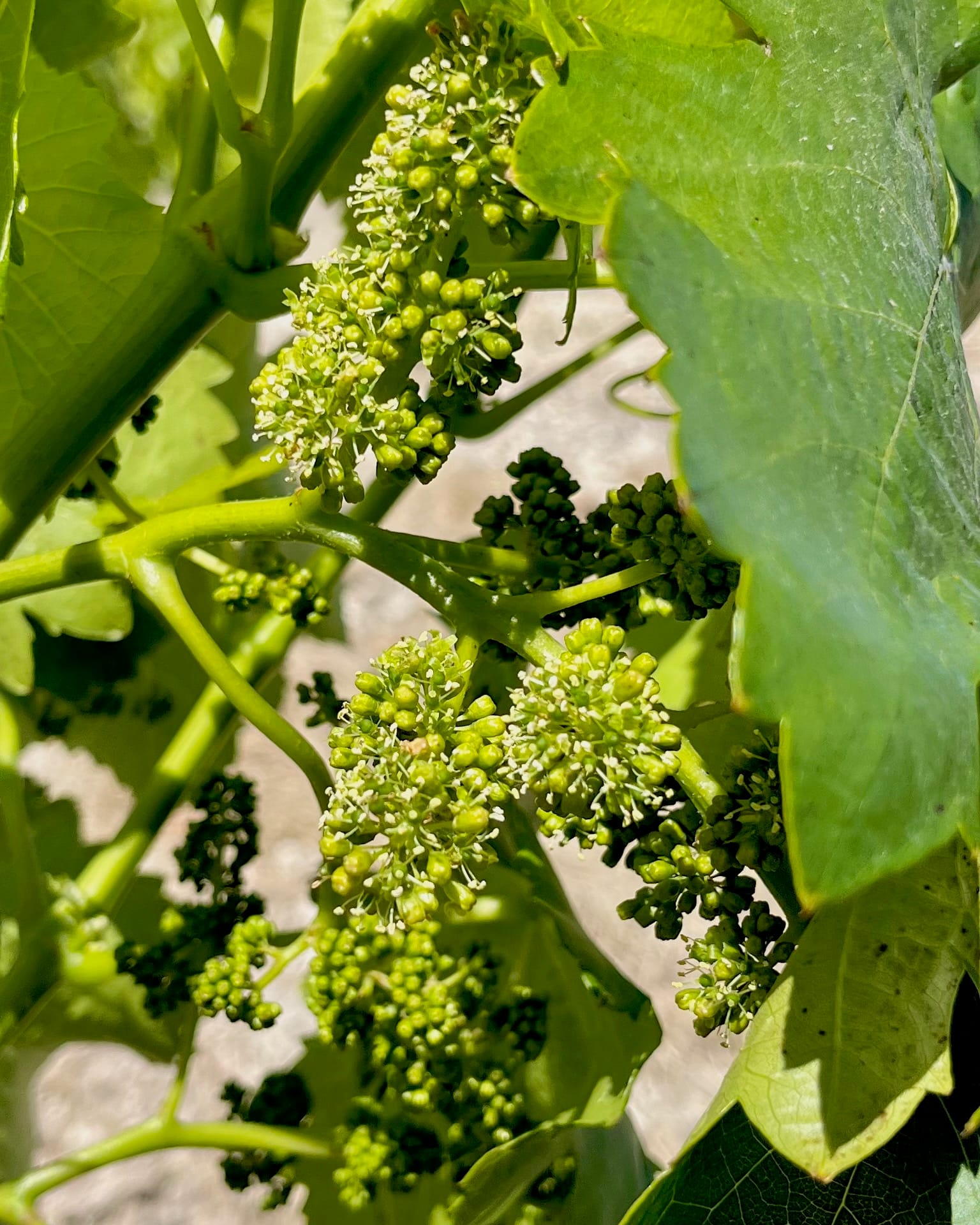
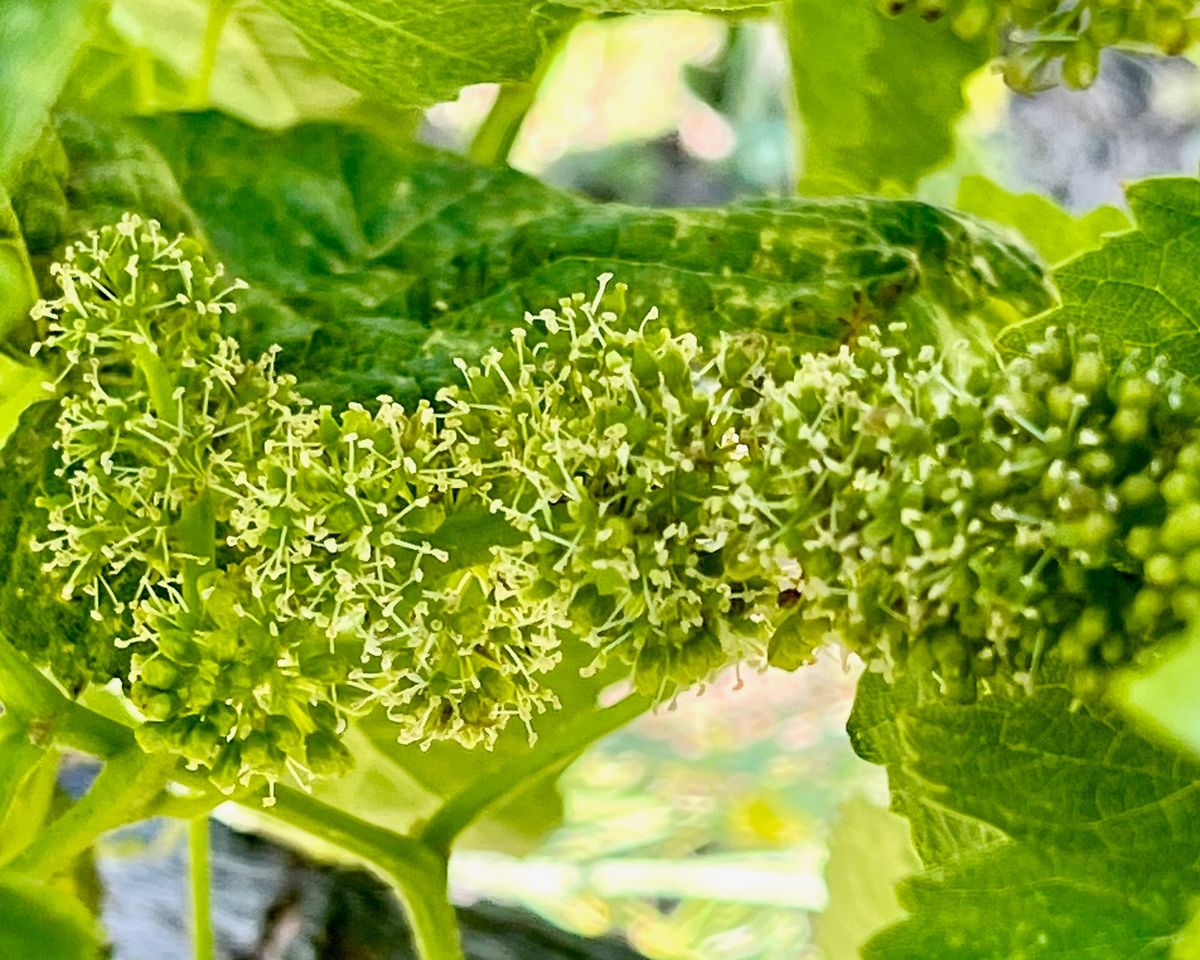
If you haven't seen grapevines flowering before, you can be excused for finding it underwhelming. It's not a showy process. Still, the tiny white fuzz-like flowers that appear on the clusters are the first stage of development of the berries. From this point on, if the berries are fertilized successfully, they'll grow in size and mass until veraison, at which point they stop growing but accumulate sugar and ripen the seeds within. As with all parts of the vineyard annual cycle, there are grapes that enter (and exit) flowering earlier and later, with the early grapes being Viognier, Grenache, Grenache Blanc, and Vermentino. They are followed shortly by Marsanne and Syrah, and finally, as much as a month after the early grapes, Roussanne, Counoise, and Mourvedre typically bring up the rear. And there is variation between vineyard blocks as well, with cooler, lower-lying areas a couple of weeks (or, spoiler alert, more) behind the same grapes at the tops of our hills.
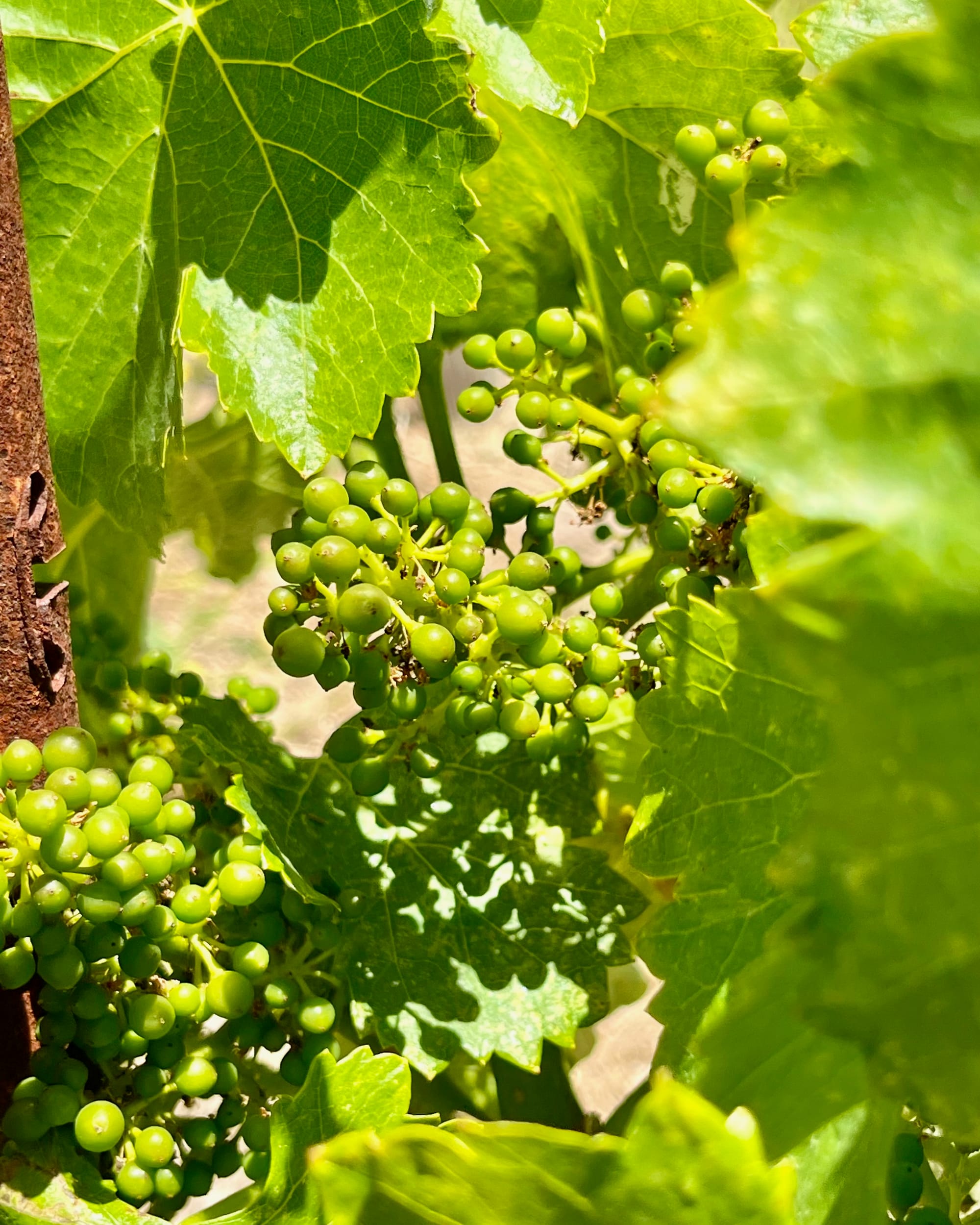
Given that it's usually a month between the beginning and the end of flowering, you might think that we'd be just finishing up by now. But it's more complicated than that. Sure, the early Grenache blocks are already showing pea-sized berries, their flowering finished before the calendar flipped from April to May:
But other grapes, like the Cinsaut below, that we would think might be only a little behind are instead just beginning their flowering:
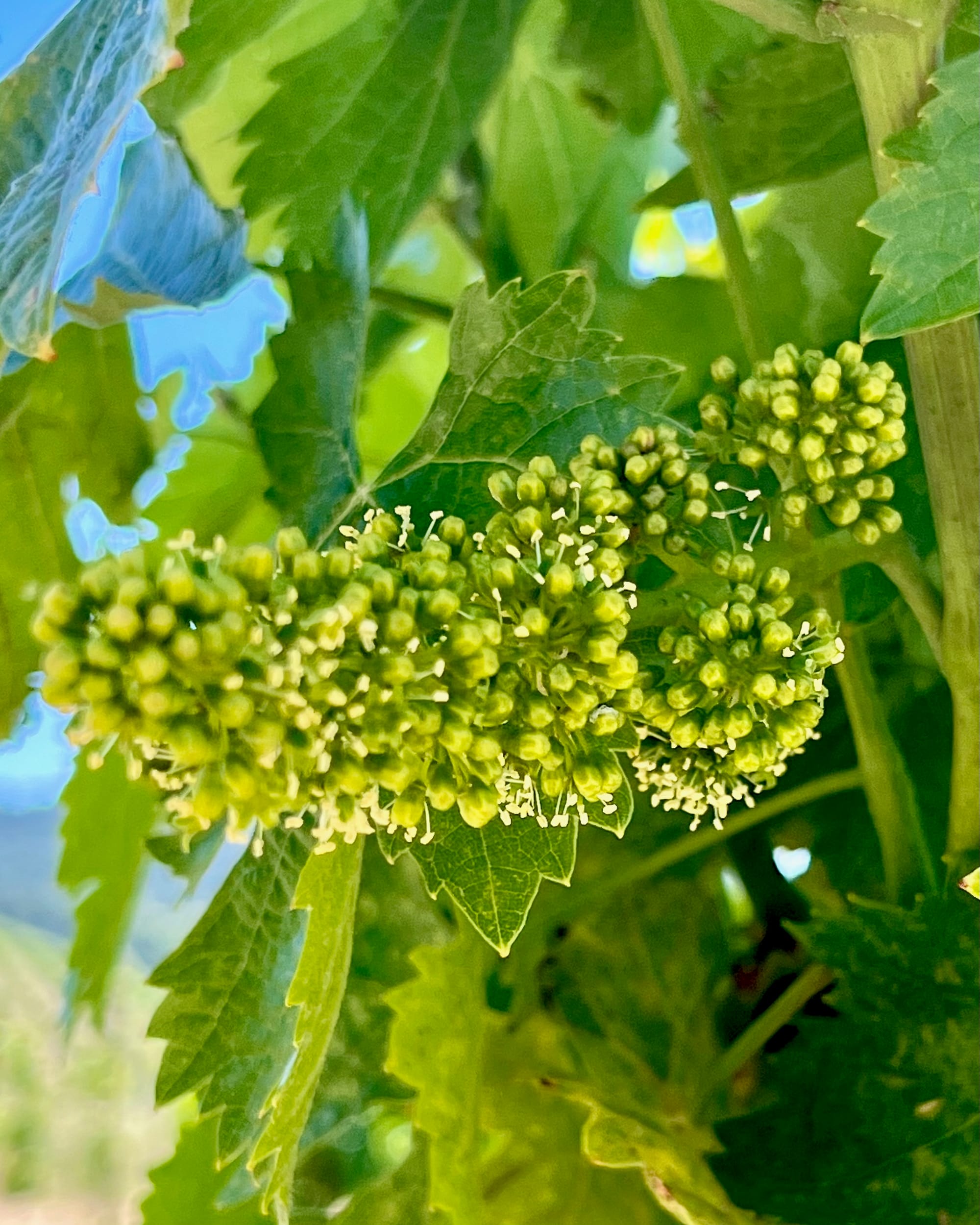
And when you look at some of the later grapes in some of our lower areas, like the Roussanne in the photo below, you've got flower clusters that haven't even started flowering yet:
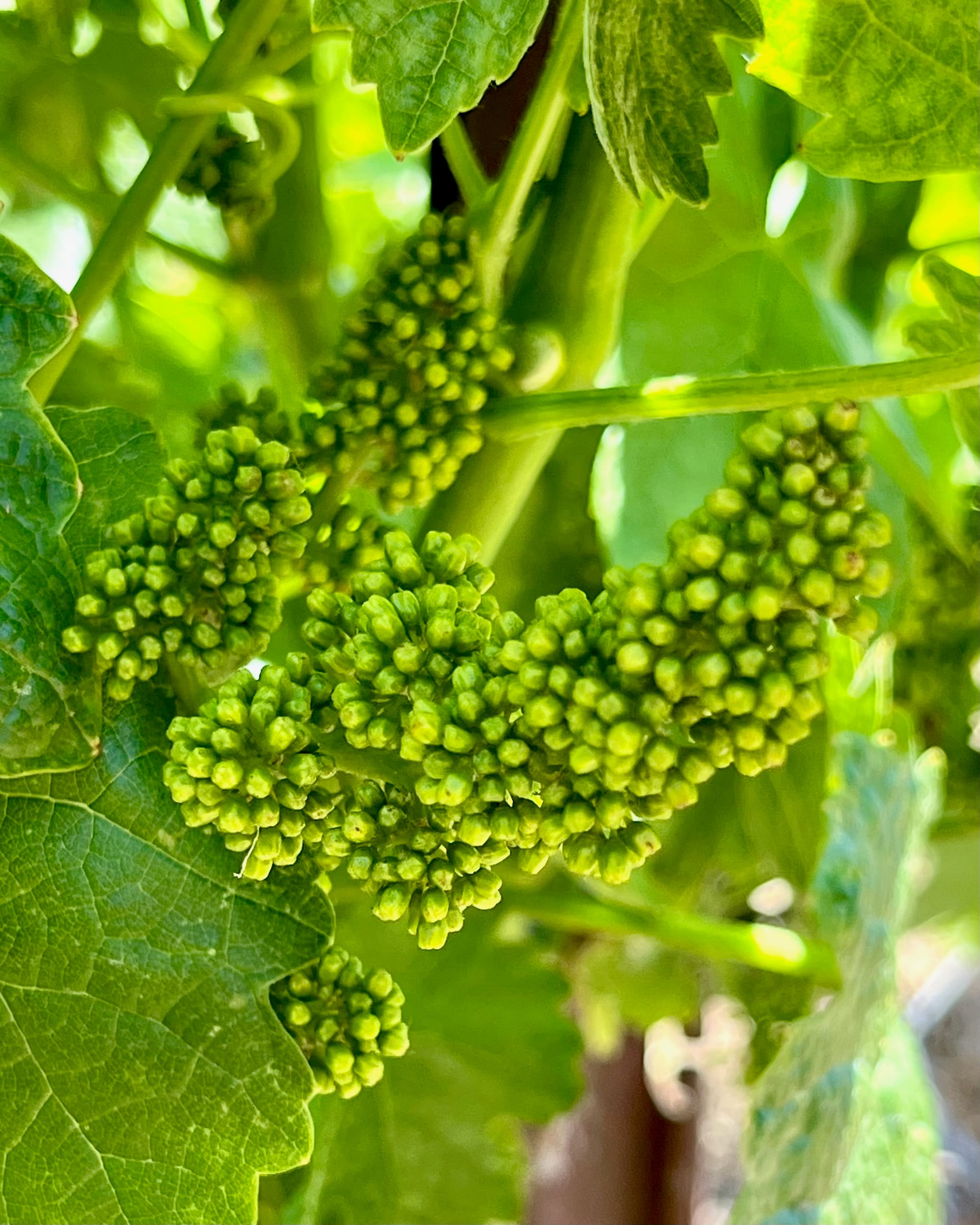
Looking at the vineyard as a whole, it seems to me that we're seeing more spread and variation than we're used to. Some grapes that are usually on the later side are well ahead of normal (like Counoise, which is almost as advanced as Grenache):
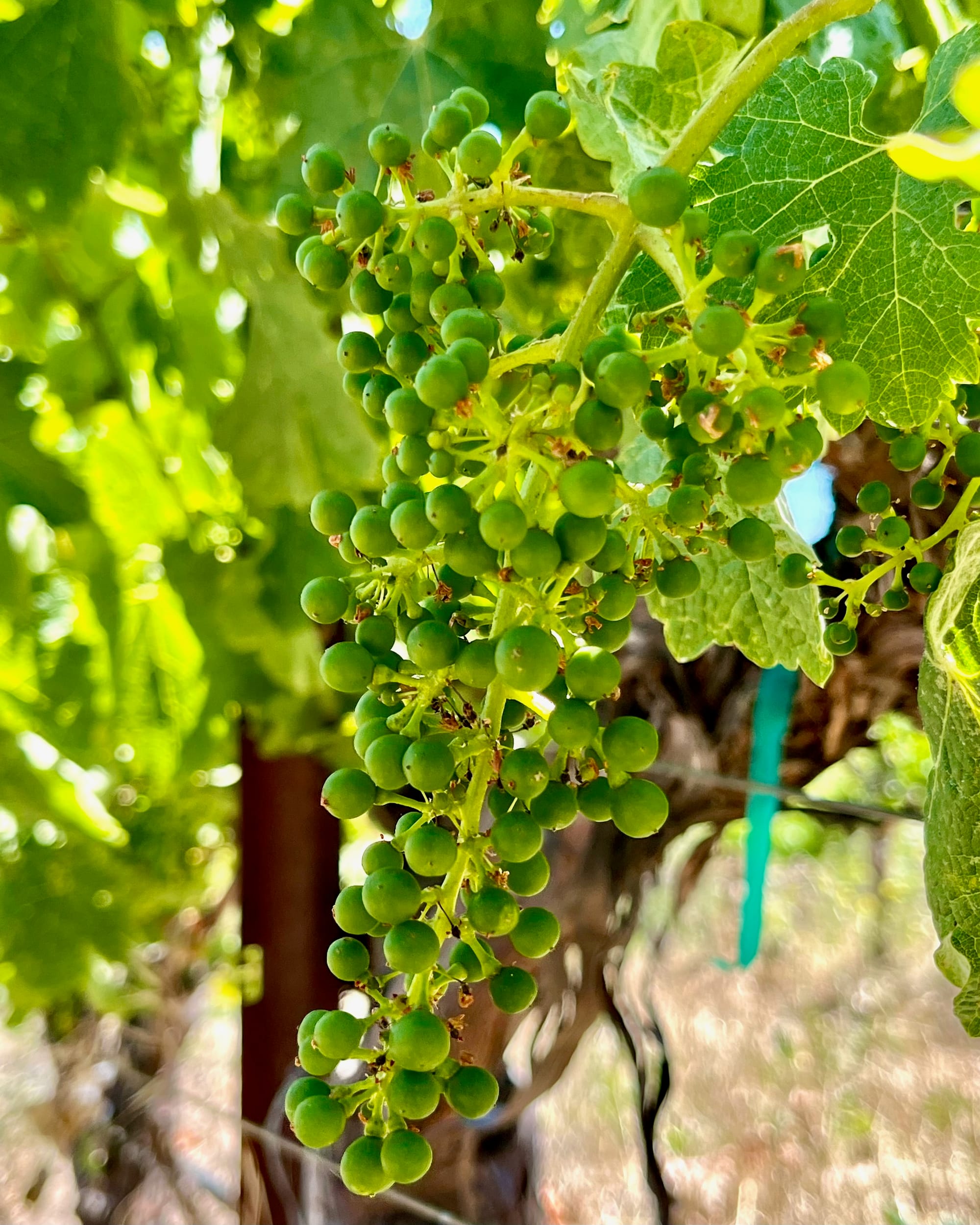
Others, like the Cinsaut I shared above, that are usually on the early side, are looking more like a late grape. That may be because of where in the vineyard it is as much as what its variety is. I walked by Counoise, Mourvedre, and Syrah blocks today and they were all at essentially the same level of advancement, at least at the bottom of the hill near the road. But higher blocks are much more advanced, again almost no matter their grape variety. Perhaps this is a function of the date of their last frost (always later in low areas than hilltops). Perhaps it's a function of one of the April nights that got chilly enough lower down to send some sort of "cool it" signal to the vines, while the higher hills never heard that message. But it suggests that we'll need to be paying as much attention to our blocks' locations as to their makeup this year. We always do, of course, but it does seem likely to be exacerbated in 2026.
Overall, we're a little less early than we were for budbreak. That makes sense given that while March was much warmer than normal, since the beginning of April we've seen essentially average temperatures. As measured by Growing Degree Days (GDDs), on April 8th we were 270 GDDs ahead of 2025. On May 15th we were exactly the same 270 GDDs ahead of 2025. The trend line for 2025 is in yellow, while 2026 is in orange:
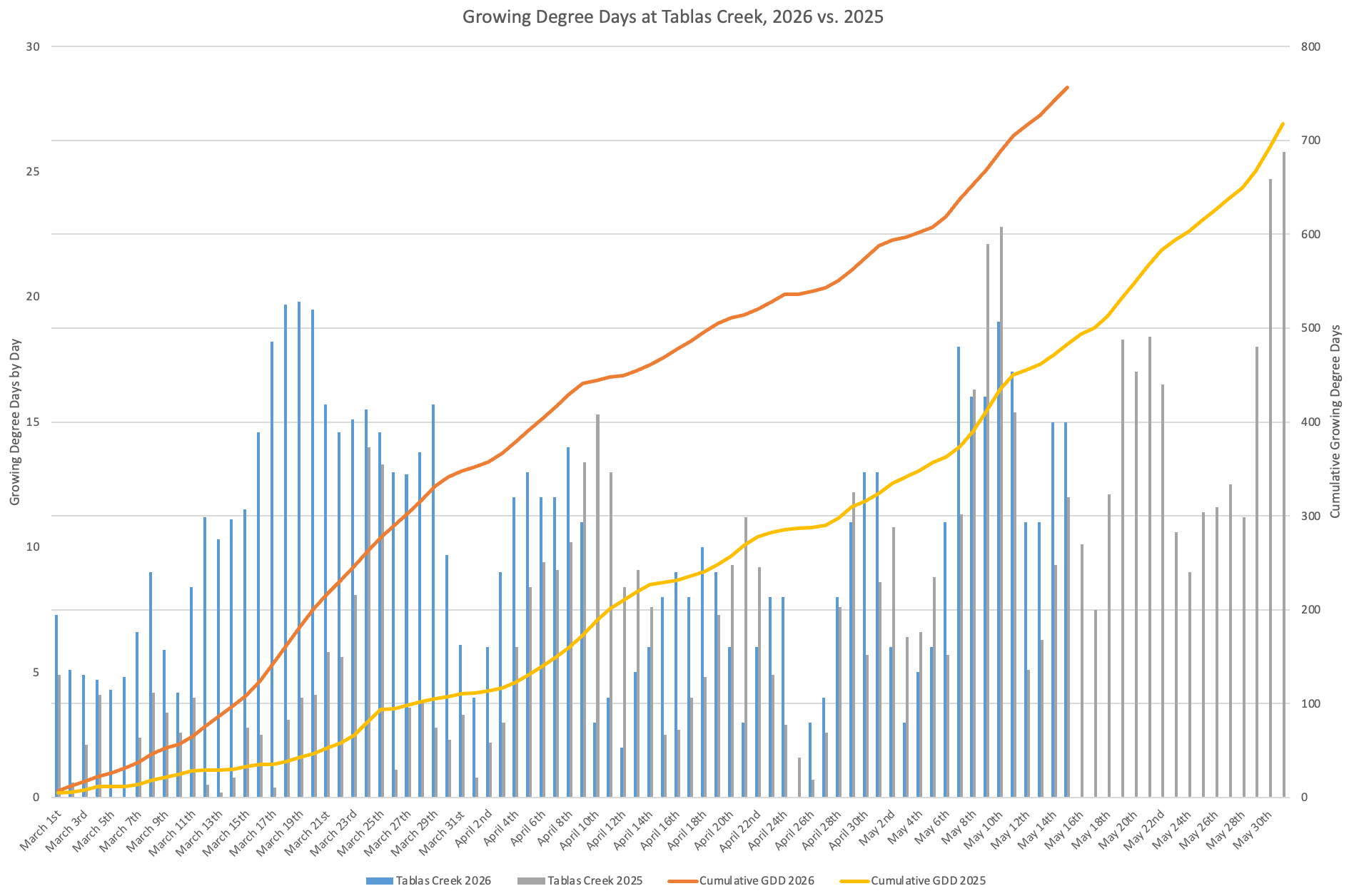
Equally interesting as comparing the Y-axis values in the above graph is looking at the difference in the X-axis, or the dates at which we got to specific heat accumulation totals. On April 1st, 2026, we'd accumulated 351 GDDs, a total that we didn't reach in 2025 until May 5th. But as of May 11th, 2026, we'd reached 704 GDDs. In 2025, we crossed the 700 GDD threshold on May 31st. So we've gone from 34 days ahead of 2025 to "just" 20 days ahead of 2025 over the last six weeks.
So, what do we expect to see going forward? Given that we still have some blocks that aren't flowering yet, we're likely to still be able to enjoy the intoxicating scent of bloom until the sometime in early June. But by that same point, some of our early grapes will likely be nearing full size. I'm projecting that we're likely to see a larger than usual spread from block to block and variety to variety for our upcoming milestones. Could we be seeing veraison in some blocks in late June or early July? Absolutely. Could we still be seeing some late-ripening blocks going through veraison when we start picking in early-to-mid August? It sure seems like it. Could we see a harvest that challenges last year's 11-week duration? It wouldn't be surprising.
If we had a direct line to the weather gods, we'd ask for consistent, sunny weather to hold through flowering, with only limited wind and no rain. Cold, wet, or windy weather at this stage can produce incomplete fertilization, or shatter, where a cluster has a high proportion of unfertilized berries, looking snaggle-toothed and (often dramatically) reducing yields. We'd also prefer to avoid any extreme heat, which can sap vines' resources before they've had a chance to get into the prime of the ripening season. The forecast over the next ten days looks pretty benign. Plenty of sun, with highs between the upper 70°s F and the mid-80°s F. That's perfect.
We've had enough anomalies for one year already. A little normal is just what the doctor (ok, viticulturist) ordered. Let's keep it going.