Harvest at its midpoint: is 2026 really early in Paso Robles, or is it just Grenache?
If we haven't already, we're about to hit the midpoint of the 2026 harvest. The story of the vintage is becoming clearer: yields on some grapes are down dramatically and ripening faster than usual, while the grapes that are seeing more normal yields are following a more leisurely path.
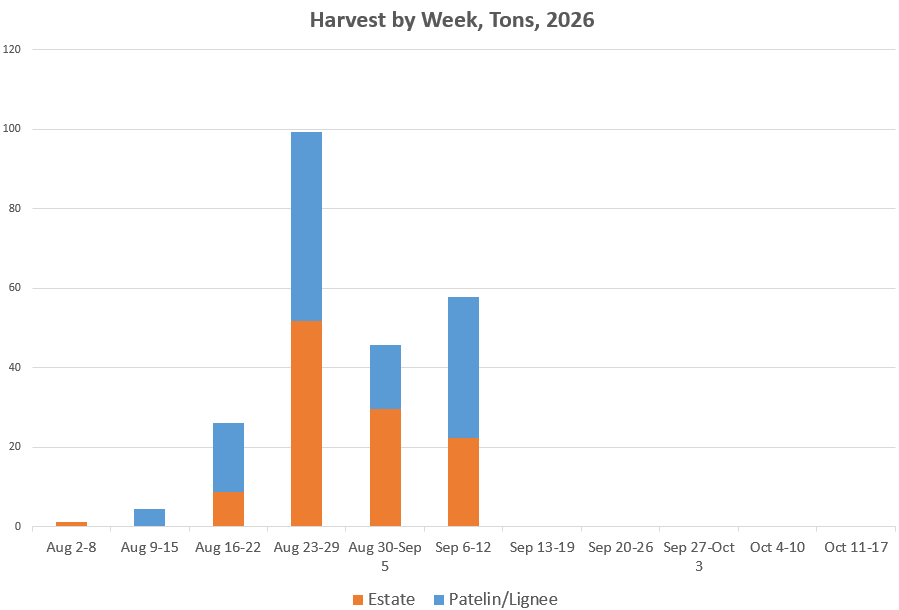
On Friday, we hit the midpoint of the 2026 harvest. We think. Or maybe it was Saturday. Or maybe it will be tomorrow. 2026 has been a hard year to wrap our heads around for a few reasons. First, the different grapes aren't coming in under the same sequence we're used to. For example, we have harvested most of our Grenache while most of our Syrah is still hanging, at a time of year when the opposite is typically true. Second, it's a vintage that isn't conforming to an easy narrative, as we're seeing grape-specific, and maybe even block-specific stories that aren't widespread. And third, as we approach harvest's midpoint, when we're used to having every tank full and the crushpad full of grapes, we're instead having multi-day lulls where nothing comes in. The graph of harvest by week is usually a bell curve. Not this year:
How did we get here?
As you would expect, the peaks and lulls of harvest correlate pretty well to the temperature spikes and valleys. A hot stretch that began August 16th fueled that big August 23rd-29th week. The cooler stretch that followed slowed things down, and the next hot stretch the second week of September fueled another burst. This sort of pattern is ideal for the vineyard (because it gives intervals of prime ripening weather followed by slower periods where the vines can recuperate) and for the harvest team (because we can process the grapes that come in and get them pressed off and tank space liberated between pulses). The below graph shows the daily high and low temperatures here at our weather station since the beginning of August:
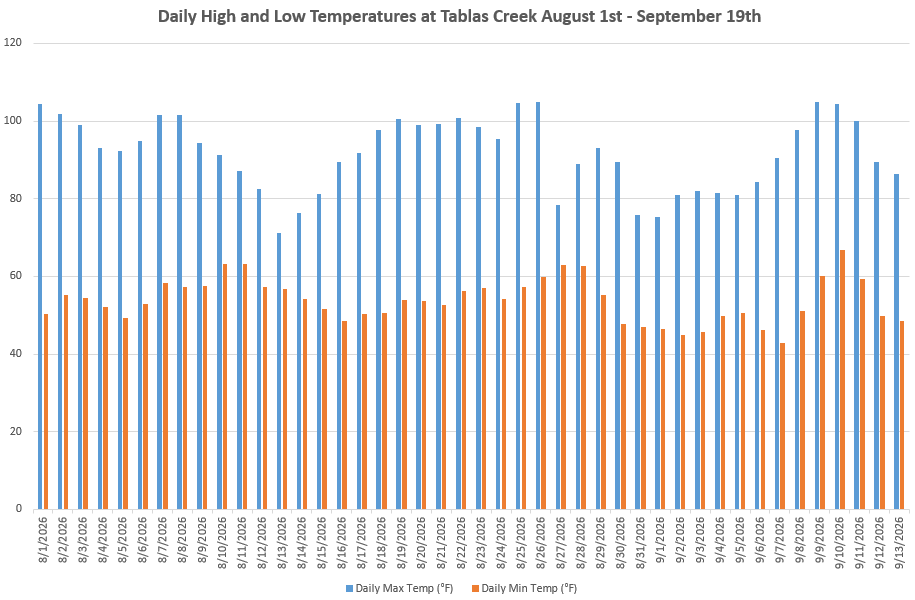
As you can see, it looks like we're entering another cooler stretch, and the forecast confirms that this week is likely to see most days top out in the mid-70s to low 80s range. That's excellent for maintaining the health of the vines and the freshness in the grapes, and makes it likely that we'll continue to see the grapes take their time before arriving.
An updated harvest tonnage assessment
As harvest approached, we combined our traditional sampling with calculations made by our new Sectormentor platform, and came up with an estimate of around 350 tons off our estate. Our long-time Vineyard Manager David Maduena, who has seen all 32 harvests here, was a little more conservative in his estimates at around 330 tons. It looks like we're going to end up below both those numbers. We've brought in about 113 tons so far, and when I asked David this morning if he still thinks we'll hit 330, he said that he thinks we'll be more like 280 or 290. If those numbers hold true, we're about 40% of the way done with the estate.
Our quantity of purchased grapes is less subject to a vintage's quirks, as we're usually not getting our grower partners' entire production, and can also pivot if something comes in light or outside of parameters. The 121 tons of purchased grapes we've received so far is about 75% of our contracted total of 160. Combined with the 280 tons I'm expecting off our estate, that's 440 tons total, and the 234 tons we've picked so far would put us at 53% complete.
While 280 tons off the estate isn't catastrophic, it would be 28% lower than last year and the 2.25 tons/acre more resembles a drought (or frost) year than what we'd expect from a wet winter and a spring where we dodged frosts. We saw similar tons per acre in 2009, 2011, and 2022 (all frost-impacted years) and perhaps most relevantly, 2015 (read our harvest journal here) when we didn't have frost but alternated between wet and dry winter months and then between warmer-than-normal and cooler-than-normal months in a growing season where no month was within 10% of normal heat accumulation.
Thankfully, we have more acres in production than we did in 2015, so we can better withstand the lower tons per acre. Still, we're looking at a roughly 100 ton decline from 2025, which means about 6,000 fewer cases of Tablas Creek estate wine.
How early are we, really?
If you follow wine media, you're probably awash in headlines about this being one of the earliest harvests ever. [If you're not, here's representative reporting from Santa Barbara, from SLO County, from Monterey, from Sonoma, and from Napa.] What we're seeing is more nuanced. Yes, we started really early; that Viognier pick we made on August 7th was a full week earlier than our earliest-ever start, way back in 1997, and three weeks ahead of average. But how much weight do you want to give to a single pick of just over one ton? Our next estate pick wasn't until August 18th. That wouldn't even have been our earliest pick this decade; we started the 2022 harvest on August 17th.
What is unusual was just how early some normally-later-ripening grapes have been coming in, particularly Grenache. We picked 31.6 tons of Grenache in August, at least half of what I'm expecting this harvest. Let's compare that to a fairly normal year like 2021, when we started picking on August 24th and brought in 28 tons of estate fruit in August. We picked our first lots of Viognier, Syrah, Vermentino, and Roussanne in August. We didn't pick our first Grenache until September 7th.
Subtracting our Grenache, we'd have picked 24 tons of estate fruit in August this year, or about 9% of our expected total. The 28 tons of August fruit we picked in 2021 ended up representing about 11% of the harvest's 270 tons. So, is the 2026 harvest early, or only Grenache? I'm leaning toward the latter, at least mostly. I'd say that overall we're about a week earlier than average, but Grenache and Grenache Blanc are more like 3-4 weeks early. We only have one Grenache Blanc block still unpicked, and that's likely coming in this week:
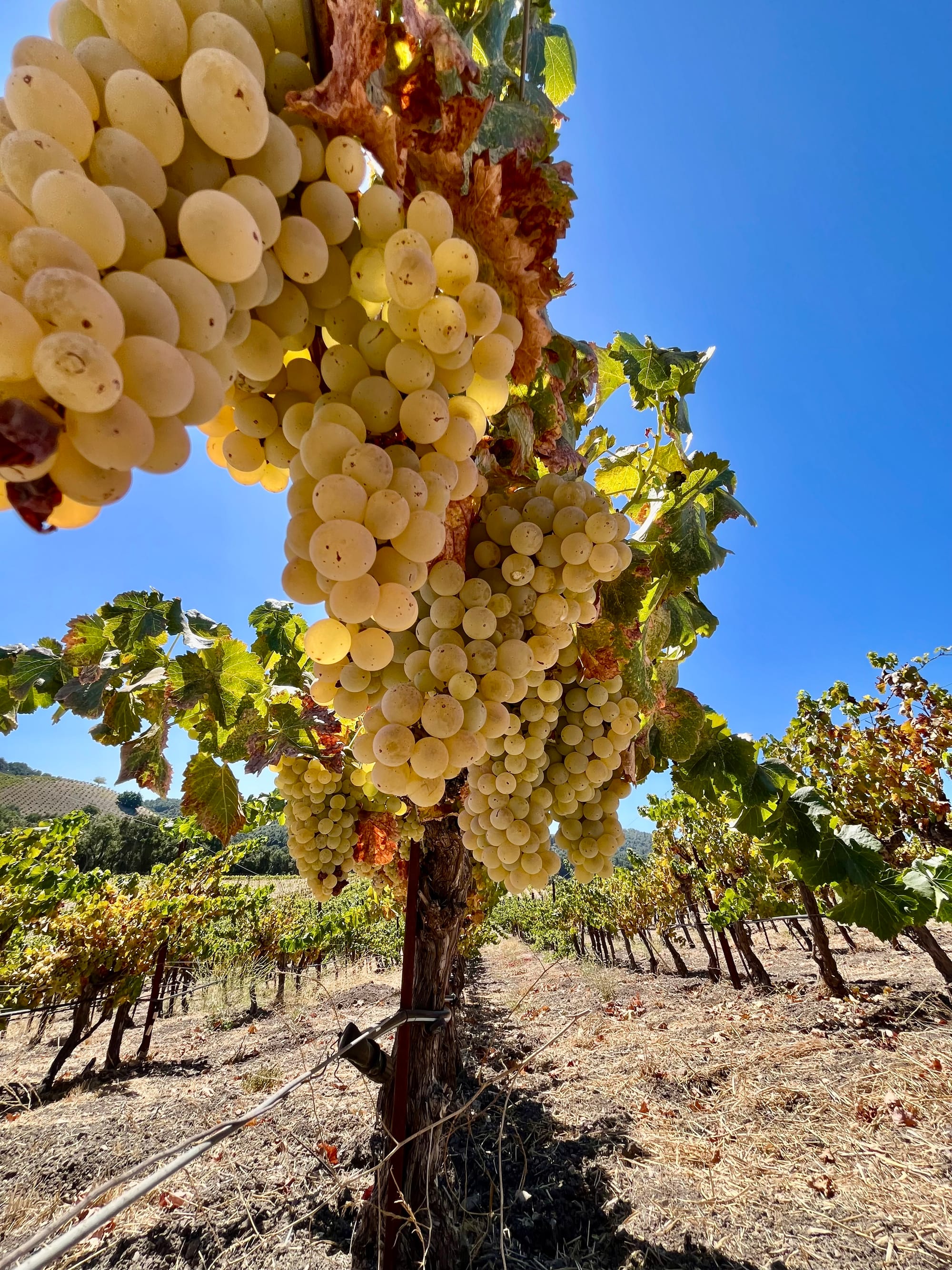
As to why Grenache is on a different trajectory than the other grapes, I think it has to do with yields compared to normal. We're expecting something like 60 tons of Grenache, compared to last year's 115 tons. That's a decline of nearly 50%. We're seeing a similar drop in Grenache Blanc, from last year's 31 tons to what I'm projecting will be 16 this year. If we do end up at around 280 tons, a decline of 107 tons from last year, that would mean that Grenache and Grenache Blanc account for 70 tons of that decline, and that our other grapes are only off about 15% in aggregate. Because grapevines with lower crop levels ripen that crop faster than grapevines with higher crop levels, it would make sense that if Grenache is down more than our average, it would be ripening faster.
At the same time, it looks like some grapes (notably Syrah, Marsanne, and Bourboulenc) are showing similar yields to last year. It doesn't appear that those grapes are much ahead of last year, if at all.
What about quality?
In my first harvest update, I pointed out that even with our very early first pick, we were likely to see longer-than-normal hang times because of just how early flowering was. That's even more true for the grapes that are coming in at normal times, despite having kicked off a month early. All things being equal, more hang time generally means more character.
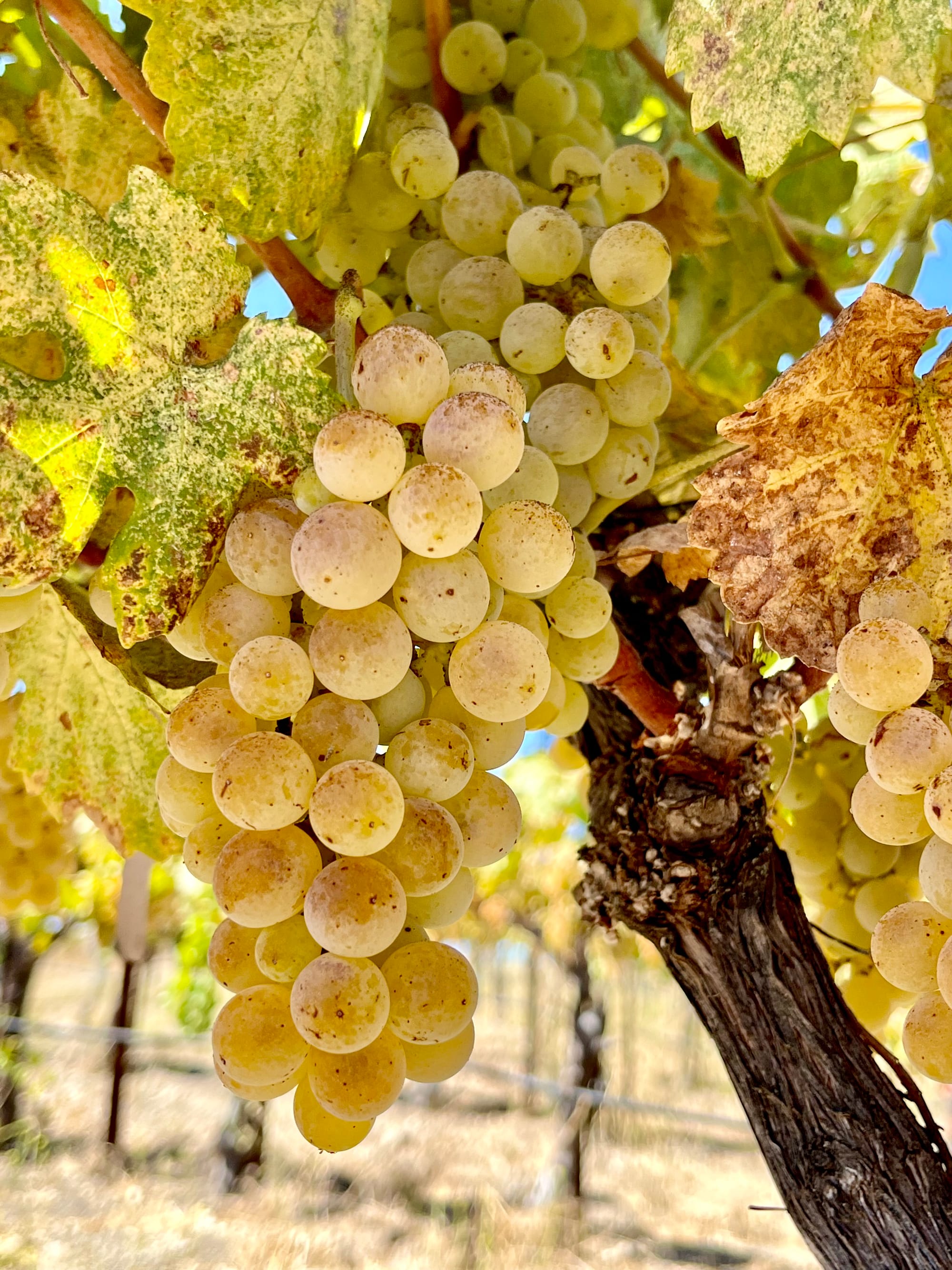
That maxim appears to be borne out by what we've brought in so far. The colors on the reds are deep and vibrant. The flavors on everything are intense and characteristic. The numbers in terms of sugars, pH, and acids have been textbook. So while we could wish for more quantity, the quality looks impeccable. Take a look at the golden color that we're seeing on this Bourboulenc cluster, and imagine the flavors. They're every bit as luscious as this looks:
So what can we expect from the rest of harvest?
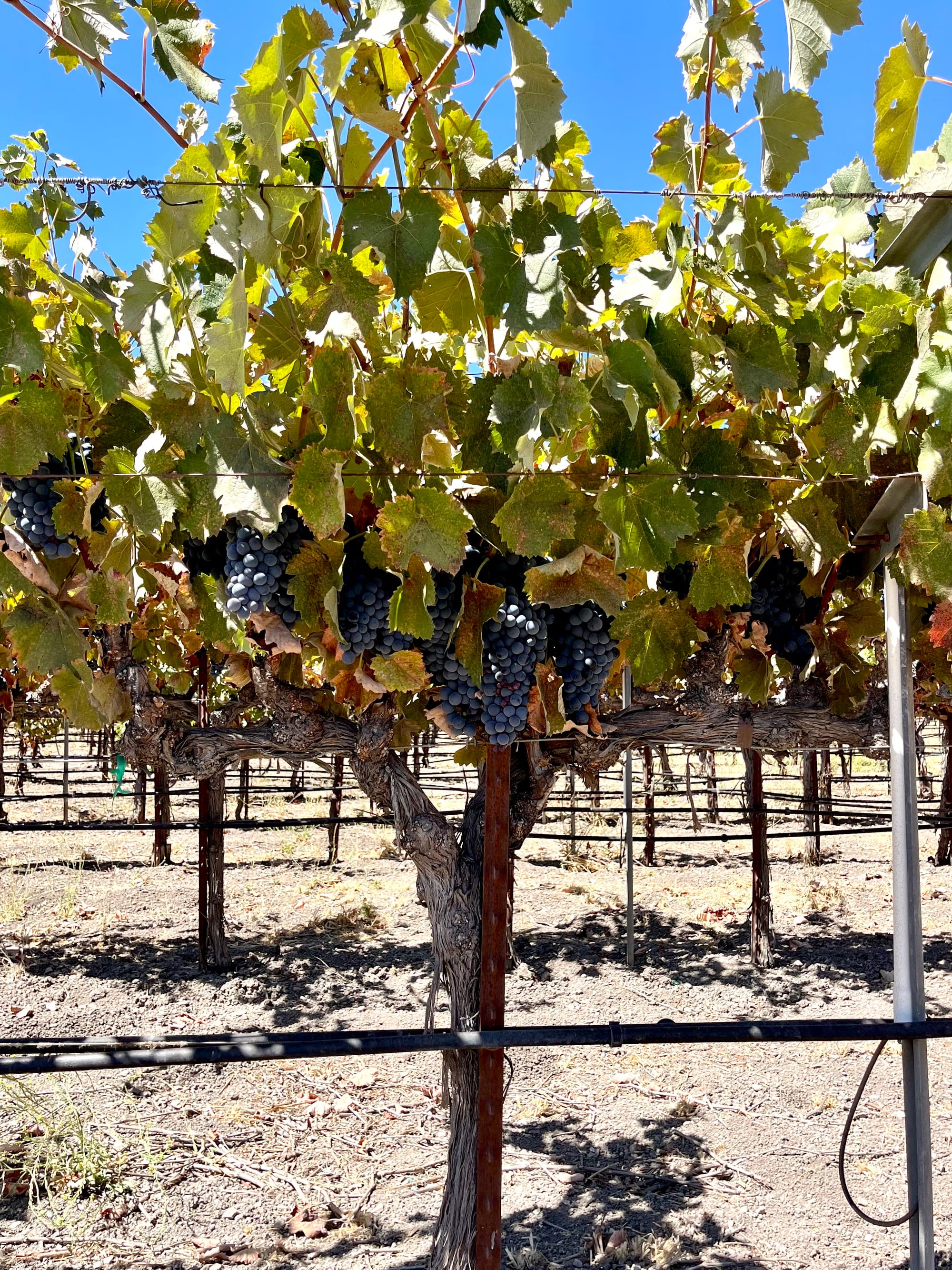
I'm not sure we know yet. We still have a little Grenache and Grenache Blanc as well as a good chunk of Syrah, most of our Roussanne and all of our Mourvedre, Counoise, Tannat, Cinsaut, Marsanne, Vaccarese, Picpoul, Picardan, Terret Noir, and Clairette still to come. In 2015, while most of our early grapes were very light, I titled our harvest recap blog Mourvedre and Roussanne (somewhat) to the rescue, because the yields on those late-ripening grapes were close to normal. It turned out that the chilly weather during flowering that pushed down yields so dramatically on our early grapes had moderated by the time those late grapes flowered a few weeks later. Will we see something similar this year? I'm hoping so, but don't feel like it will play out exactly the same way. Instead, it seems like the first grapes to sprout were the most affected by whatever weather conditions drove down yields, while the middle-sprouting grapes like Syrah and Marsanne were the least affected. Our late grapes like Roussanne, Mourvedre, and Counoise feel somewhere in between, down though not as much as the Grenaches. Perhaps because of the lighter yields, they look great. Just look at this Mourvedre, still green and looking more like July than September:
If our early grapes turn out to be off by around 50%, our mid-season grapes stay at normal yields, and our late-season grapes are down around 25%, we'd end up very close to the down-28% that David's estimates suggest.
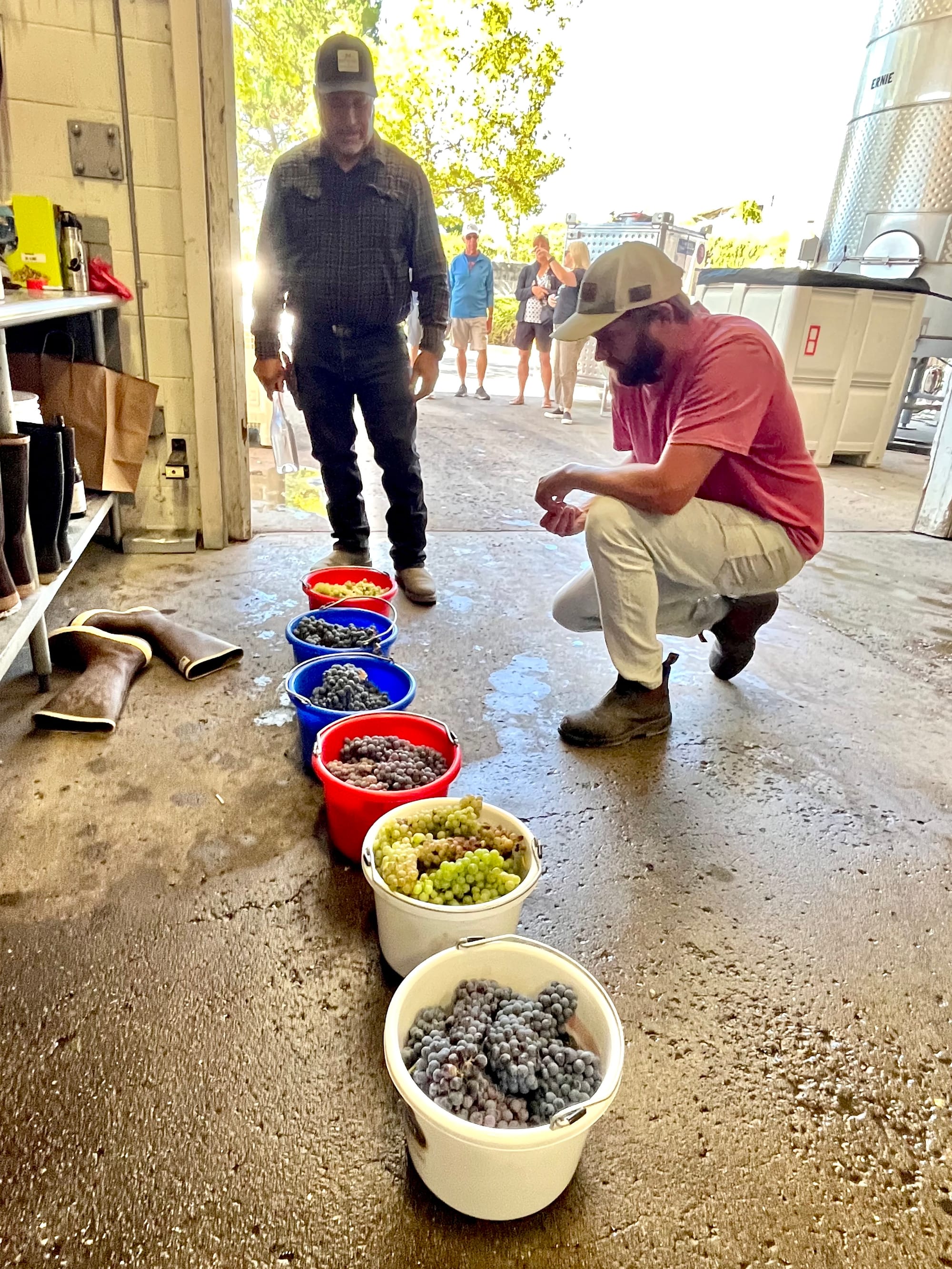
We'll know more soon. This week we'll be bringing in a lot of Syrah as well as most of if not all of the rest of the Grenache and Grenache Blanc. We're also doing a lot of sampling to make sure we have a handle on the blocks and varieties that haven't been a focus so far. I love this photo of Vineyard Manager David Maduena and Winemaker Craig Hamm checking out the cluster samples David just brought in:
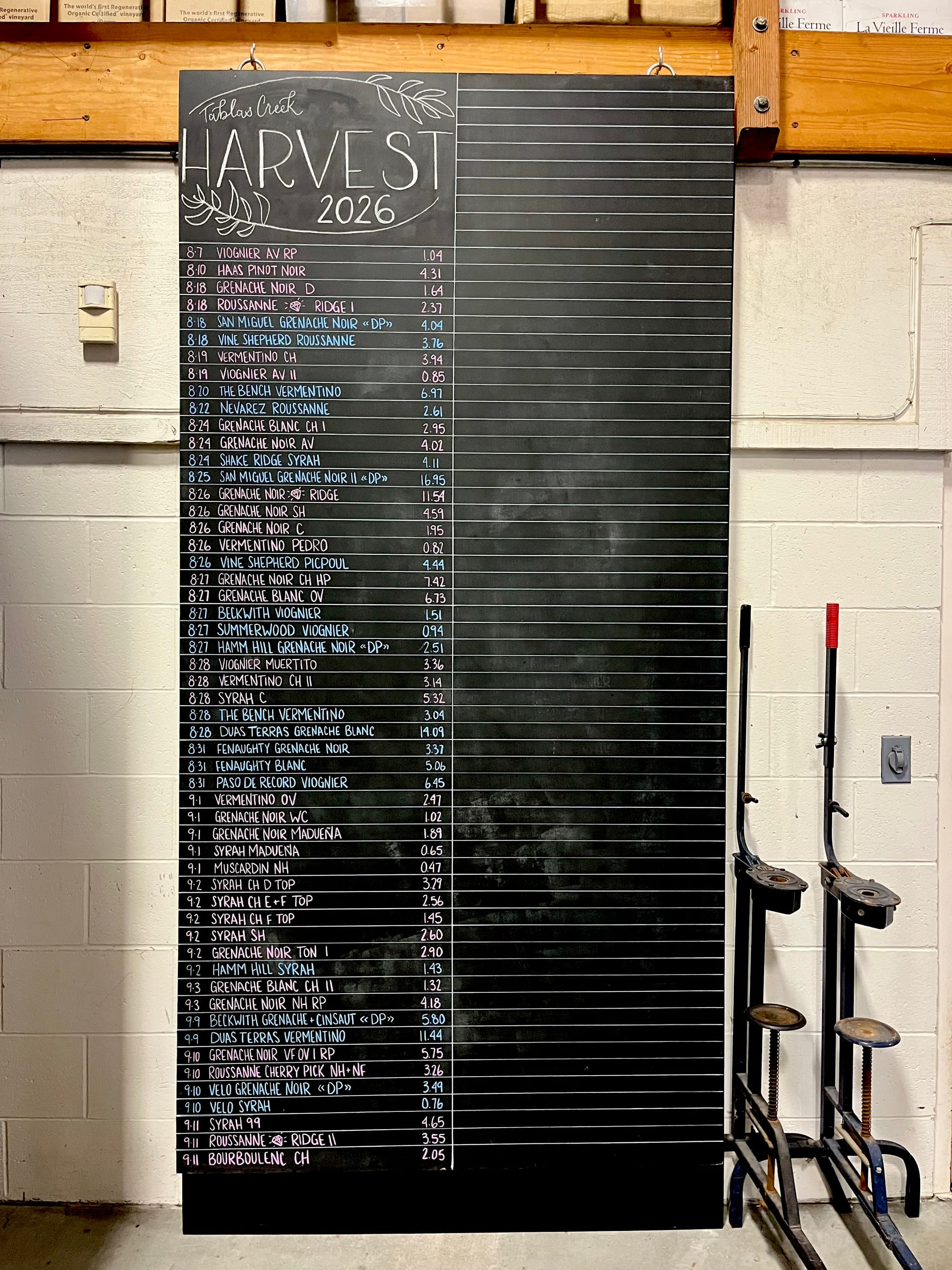
And while this is a fully non-scientific metric, it somehow feels appropriate that we ended last week having reached the bottom of the left-hand column of our harvest chalkboard. Harvest midpoint, it is.